Yes, on five conditions: you want a blowout rather than curls, your hair is no longer than about chest length, you will style weekly or more, you do not already own a dryer you like and an iron you can use, and you will give it a month on an easy return window. No if you want curls that hold without working a routine for them, and no regardless if your hair is long, heavy or virgin.
That split is not the one most people expect. I read a lot of these threads looking for the fine-versus-thick line everyone assumes exists, and it is not there. Thick-haired owners are among the loudest fans, because the tool turns an hour of drying into twenty-five minutes. Fine-haired owners are among the loudest complainers, because their curls fall out. What separates them is what they wanted the tool to do.
One thing the title cannot carry. It is worth it as a blowout tool, and worth the premium over the much cheaper Shark FlexStyle only if you want the reversible barrel and the better controls, because the owners here who used both say the machines work the same.
The short answer, and the conditions attached
Buy it if you want a salon-style blowout at home and cannot work a round brush and a dryer at the same time. Skip it if you want curls that hold without working a routine for them. That is the cleanest line through five years of owner discussion, and everything else on this page is the detail underneath it.
The other four decide the rest. Past chest length the standard barrels stop reaching and sessions stretch past forty minutes. The learning curve is real and roughly a month long. And if you already own a good dryer and an iron you can use, the community’s own answer is a cheap blow-dry brush, not a premium ($$$) styler.
What we did and did not do
We do not own an Airwrap and have not put one on anyone’s hair. This page is a synthesis: 91 public Reddit discussions across five years, 21 of them read comment by comment, plus what Dyson and the Amazon listings claim. Every claim below is an attributed owner report or a manufacturer claim, plus one cited dermatology source.
That matters here, because almost everything else ranking for this question is one person’s experience with one head of hair. That is real, and it cannot tell you whether you are in the happy group.
Two limits up front. The discussions skew to straight, wavy and looser curly hair; how it performs on tightly curly, coily and African hair is asked at least three times and never answered by anyone who has done it. And most of the corpus predates the i.d., so the model section rests on the thinnest evidence here and says so.
The two product links below are affiliate links. If you buy through one we may earn a commission, which does not change the verdict or the owner reports.

Dyson Airwrap i.d. Multi-Styler (Straight+Wavy)
Best for: At-home blowouts on straight-to-wavy hair up to about chest length, styled weekly or more.
A six-in-one air styler that dries and shapes in the same pass, with a personalized styling profile in Dyson's app.
- Owners who could never work a round brush and a dryer at once get a salon-style blowout from one tool.
- Big time saving on thick hair: one owner went from about three hours to an hour and 15 minutes, another from close to an hour to 25 minutes.
- Light enough to use one-handed, which an owner with limited use of one side credits for being able to style at all.
- Curls drop for a large share of owners: we counted 38 separate reports across 19 discussions, some inside half an hour of curling.
- Several owners say it is not hot enough to smooth or hold their hair, and some report frizz at the roots and crown from the airflow.
- Fussy to get right: hair has to be about 80% dry, the standard barrels run out of length past the chest, and the plug is built for one country so it does not travel.
(Affiliate link) · price may vary
The Airwrap i.d. is the current straight-and-wavy kit, premium ($$$) at around $649, and what Dyson calls its first connected hair care device: it pairs over Bluetooth with the MyDyson app, which builds a styling profile from six questions about your hair. The Amazon listing calls it engineered for straight and wavy hair and sells it as a six-in-one that dries, curls, waves, shapes and smooths. A curly and coily i.d. kit exists at the same money.
Two things to check on the listing before you buy. Confirm the seller is Amazon or Dyson, because the one warranty refusal in our threads that anybody defends turns on a unit bought from an unauthorised reseller. And read the return terms on the page: we have not verified what window this listing carries, and the return window is one of the five conditions.
The honest line, and the reason this page is not a recommendation: curls drop for a large share of owners, and we counted 38 separate people saying so across 19 discussions. Several others report it is not hot enough to smooth or hold their hair, and some get frizz at the roots and crown from the airflow. It is also fussy: hair has to be about 80% dry, the barrels run out of length past the chest, and the plug is built for one country, so it does not travel.
Dyson · (Affiliate link)
Who it is worth it for, and who should skip it
Worth it if you want a blowout, your hair is shoulder to about chest length, you style weekly or more, you own no dryer you like, and you will give it a month. Skip it if you want curls that hold without a routine, your hair is past chest length, or you style once a month.
Five conditions decide it, and they are not weighted equally. What you want the tool to do is the one that settles most cases. The other four break the ties.
| The question | Buy it if | Skip it if |
|---|---|---|
| What you want it to do | You want a smooth, voluminous blowout and cannot manage a round brush and a dryer at once | You want curls that hold without working a routine for them |
| Hair length | Shoulder to about chest length | Past chest length, where the standard barrels stop reaching and the long barrels may be a separate purchase; check box contents |
| How often you style | Weekly or more | Once a month, where the cost per use never comes down |
| What you already own | Nothing you like, or a dryer that takes you an hour | A dryer you are happy with and an iron you can use |
| Patience | You will give it a month, a return window and probably a lesson | You expect it to work the first time out of the box |
One commenter put the cost-per-use question plainly: once a week is defensible, once a month is not. That row is the least glamorous and the most useful.
What owners say goes wrong
The curls dropping is the loudest complaint in five years of discussion, and it is not close. We hand-counted 38 separate owners across 19 threads saying the curls fell out on them. Reported hold runs from gone thirty minutes after curling, before the owner had left the house, to not quite two hours, to flat within an hour or two.
Against that, 14 owners in the same corpus report hold from a full day up to four days, and almost all of them name the same three steps: start damp rather than wet, cool-shot every section, and pin or spray the curl while it cools. One poster with waist-length thick hair gets a full day of curl and then two more days of blowout. Another with bra-strap-length wavy hair gets four days. A third, stick-straight and heavily bleached, uses the large barrel and gets curl that lasts until the next wash, four years in. All three are long-haired, which is why we treat length as a barrel-reach problem rather than a hold problem.
So the tool can hold a curl. It holds for people working to a routine and drops for those who are not, and a third factor nobody can fix: long, heavy, virgin hair resists curl from any tool. One parent posting about a 14-year-old’s hair had done the heat, the cool shot, the pinning and the hairspray, and still lost it in two hours. One owner adds the caveat that undoes all of it: in any humidity, the curls will not last ten minutes.
Then there is the heat tension, the most interesting thing in the corpus. Dyson’s own product page advertises the i.d. as a faster, easier way to achieve long-lasting curls with no heat damage, carrying its own footnote marker on the curls. Owners say the opposite problem: one comment with 52 upvotes says flatly that there is not enough heat to smooth hair and hold it, and others say the ends stay ragged. A tool marketed on not being very hot is being bought by people who need heat to make a style stay. The owners who get results resolve it in practice. It has heat settings and the people with hold use them: a 127-point owner always uses them and says the cool setting takes longer to set and holds worse on fine hair, another runs it on the highest setting against frizz and would not call it heatless, a third puts it at about a dryer or an iron on low. Do not let the no-heat-damage footnote talk you into running it cool.
Frizz at the roots and crown comes up independently from at least five owners, and one explains the mechanism better than any review we found. Air leaves the barrel in all directions, including upward along the shaft, which lifts the short hairs around the crown and roughs up the ends, and the brush attachments give you no way to aim it down the length. One owner with fine hair says it leaves their hair fluffy rather than smooth. If you bought it to kill frizz, watch for this in your return window.
The damp window is narrow and it catches people out. Too wet and the drying takes forever; too dry and the curl will not take. The corpus converges on about 80% dry, which means air-drying or rough-drying first. Owners who get it right say the bad results they see are usually on sopping-wet hair.
Time depends on your hair, and the spread is enormous. The fast camp reports 15 to 20 minutes for a full head. The slow camp reports 40 minutes to curl, about an hour on very thick straight hair, and 75 minutes on long thick curly hair. Density and length drive it, mostly not technique. With a lot of hair, plan for the top of that range.
A few smaller things, each at the weight of its evidence. Some owners report creases where the hair sits against the barrel vents; that is one thread with two comments in it, one of which blames a short barrel on long hair rather than the tool. Long hair outruns the standard barrels, and one owner with waist-length hair gets curl only on the last two or three inches. The long barrels may be a separate purchase, and we could not verify which ship in the straight-and-wavy i.d. box: neither Dyson’s page nor the Amazon listing publishes the box contents. If your hair is past the chest, check before you buy. A single owner says it roasts the ear on face-framing sections. Noise splits owners completely, so we would not lean on it.
Two failure modes have fixes, and the first is maintenance. The highest-scoring Airwrap-specific thread in our corpus, at 643 points, is a 2019 owner whose machine started shutting off after two or three minutes, flashing a light and giving off a burnt-hair smell they assumed was their hair frying. The cause was a filter never cleaned in more than five years plus hair wound inside the body, and a 20-minute clean fixed it. A commenter whose brother works at Dyson says nearly all repairs come down to dirt somewhere. Treat that as a maintenance schedule, not a defect.
The second is counterfeits, a real purchase risk at this price. Owners describe fakes on Facebook Marketplace, units bought cheaply overseas and resold at full price, and a whole thread of people authenticating a gift. Buy from a retailer.
How long it lasts is the question a premium buyer asks first, and the corpus cannot settle it. A thread asking exactly that drew answers naming only 2020 and 2021 units: two still going (one under salon-level use), one getting weaker, and one bare “Nope” with no detail. Nobody reports on a 2018-era machine. The attachment hardware turns up separately: a brush head breaking off at about two months (191 points), the clip holding an attachment on popping off within two weeks (109 points), a unit dead after a handful of uses, a filter light stopping a machine at six months. Dyson publishes its warranty term on its own site and we did not verify the length, so check it before you buy.
One more, flagged as thin: a single owner reports two replacements in two months on an i.d., the exact generation this page is about. That is one person. We will not build a verdict on it, and we will not leave it out.
What owners say goes right
The happy owners are consistent about what they are happy about, and it is almost never curls. It is the blowout. People who could never coordinate a round brush and a dryer get a salon-looking finish from one tool, and some say plainly that this is the only thing they wanted it for.
One asymmetry to name. We hand-counted the headline complaint and did not count the praise, because satisfaction here is spread across whole worth-it posts rather than discrete reports, so a count would be of posts, not of people. We will not publish a number we cannot stand behind.
The time saving on thick hair is the strongest positive case in the corpus. One owner with long thick curly hair went from about three hours, soaking wet to smooth blowout, down to an hour and 15 minutes. Another went from close to an hour of drying, still not fully dry, to 25 minutes. A third can look salon-fresh less than half an hour after a shower. When people say the Airwrap paid for itself, that is the calculation, and it holds if you dry a lot of hair several times a week.
The most distinctive story in the whole corpus is an accessibility one. A performer with MS who has limited use of one side cannot safely use a traditional curling iron, styles the Airwrap one-handed, and touches up sagging curls between sets in under five minutes without waiting for an appliance to heat. A second owner makes the same point about low weight and one-handed use with mobility issues. That case shows up in no review we found, and for the people it applies to it may outweigh everything above.
Last, the tool-replacement case. Several owners use the flat and round brush attachments almost exclusively, never touch the curling barrels, and get silky straight results in 10 to 15 minutes. One who says the curls will never hold still loves it for drying and smoothing at every wash. If that sounds like an expensive dryer with good brushes, you have read the corpus correctly, and our hair dryer roundup works through the cheaper version.
Which model, and does the 2026 one change the answer?
Buy the i.d. if you are buying new, and treat this section as the weakest evidence on the page. Most of our discussions predate the i.d.; the 2026 Co-anda2x appears in three comments in one thread, and only one describes anyone using it. What follows leans on the listings more than on owners.
The one strong owner signal is the highest-scoring model comment in our threads, at 72 points: the newer machine is lighter and smaller, and that is the one to get if you are buying now. The i.d. is the app-connected model, sold in a straight-and-wavy kit and a curly-and-coily kit at the same money.
The Origin is Dyson’s simplified version, three styling attachments instead of the full set, and the Amazon listing describes intelligent heat control measuring air temperature over 40 times a second. Do not assume the Origin is the saving: fewer attachments does not guarantee a lower price, so compare the two listings on the day before you buy the cheaper-sounding box.
The Co-anda2x is the 2026 machine. Dyson’s listing copy calls it 30% more powerful with twice the air pressure from a Gen2 motor, and claims full hair-dryer performance. It carries 18 Amazon ratings as of September 2026, too few to tell you anything, and our threads contain one owner’s girlfriend upgrading to it because the i.d. could not cope with her length. If long hair is your problem, that is the only signal pointing at the new model, and it is one data point. Dyson says all attachments are fully compatible with previous Airwrap devices, which lowers the cost of upgrading the body later.
The other route owners take is refurbished. Dyson sells renewed units with a warranty, and one owner who bought that way says theirs looked brand new; others buy refurbished through resale sites. On a tool with this much buyer’s remorse attached, a cheaper entry with a warranty is a sensible hedge.
The cheaper-rival question: the Shark FlexStyle
Shark, unless the price difference is irrelevant to you. The strongest evidence comes from the one owner who bought both at the same time, specifically to keep one and return the other. Their conclusion: the machines work identically, with no difference visible even side by side. They kept the Dyson for the discount and the reversible barrel.
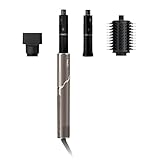
Shark FlexStyle Air Multi-Styler & Drying System, Mocha Silver (HD431BR)
Best for: The same one-pass blowout for roughly half the Dyson's money, and the tool owners switch to on price.
Rotates from a hair dryer into an air styler, with temperature measured and regulated 1,000 times a second.
- The one owner in our threads who bought both at the same time specifically to keep one and return the other found the two machines worked identically.
- That owner rated the Shark higher on grip, on its blowout brush and on how strongly it grabbed sections.
- Light in the hand at about 1.5 pounds, and the listing covers straight, wavy, curly and coily hair.
- Hair gets caught in the middle of the tool, the highest-scoring complaint about it anywhere in our threads.
- Curls drop here too: one owner gets three hours at most against all day from a curling iron, and another uses it only to refresh curls rather than create them.
- Owners split hard on noise (one returned theirs as too loud, another calls theirs quiet), and one owner says its lint filter wants a weekly clean or it overheats.
(Affiliate link) · price may vary
The FlexStyle is around $230, still premium ($$$) but roughly a third of the Dyson’s around $649, and it rotates from a hair dryer into a styler rather than being a styler that also dries. Shark’s listing claims it measures and regulates temperature 1,000 times a second, puts it at about 1.5 pounds, and says it is designed for straight, wavy, curly and coily hair.
The buy-both owner rated the Shark’s grip more comfortable, its blowout brush better for their hair and its airflow stronger at grabbing sections, and gave the Dyson the win on noise and the buttons. A second owner who has used both puts it further towards the Shark, calling it the better dryer. The counter, at 127 points, is an owner who finds the Dyson easier to use and smoother in the result than their mother’s Shark. On the review records, the Shark listing carries 4.3 stars across about 2,500 ratings against the Dyson listing’s 4.1 across about 560, and the Dyson sits on this page under an editorial exception to our 1,000-review floor because it is the subject of the question.
The honest line: hair gets caught in the middle of the tool, the highest-scoring complaint about it in our threads at 421 points, from an owner who rates it a fair trade for how much use they get. Curls drop on the Shark too, which matters because people recommend it as the fix for the Dyson’s headline flaw and it is not. One owner gets three hours at most against all day from a curling iron; another uses it only to refresh fallen curls. Owners split hard on noise: one returned it immediately as too loud, another calls theirs very quiet, and the buy-both owner puts it a touch louder than the Dyson and no worse than the dryer it replaced. And one owner says its lint filter wants a weekly clean or it overheats.
Shark · (Affiliate link)
One thread you will find if you search is titled as a warning not to buy the FlexStyle. Read it before you weigh it: it is a 2022 complaint about an order on Shark’s own website being charged and then cancelled a month later, with two people confirming and a third saying theirs arrived in a week. Nothing in it concerns how the tool styles hair, and we would not let it move your decision.
Our decision rule: if the blowout is the job, the corpus does not support paying double, and the Shark is the sensible buy. If you want the reversible barrel and the better controls and the money is not deciding, the Dyson is the nicer object. Neither will give you curls that hold if your hair does not hold curls.
Cheaper routes owners actually switched to
Four alternatives come up over and over: a dryer plus a round brush for the blowout, a blow-dry brush for the same job cheaper, a curling iron for curls that hold, and a diffuser for curly hair. Each beats the Airwrap at exactly one job. None does all of them, which is the actual pitch for the Airwrap.
A dryer plus a round brush is the first and the most common. One owner returned their Airwrap for a dryer and a good round brush, and goes from wet to blowout in 15 minutes. If that is your route, our hair dryer roundup covers the fast-airflow options for a fraction of this money.
A blow-dry brush is the budget version of the same idea. The Revlon One-Step is named repeatedly, and one owner of both says they reach for the Revlon far more than their Dyson. We carry no product record for one, so we will not quote a price, but it is the cheapest honest answer to the blowout problem, and one owner relays that their stylist, asked about the Airwrap, said any blow-dry brush would do the same job.
For curls that stay put, owners are blunt: use an iron. One owner reports seven minutes with a straightener against 40 with the Airwrap, and others say an iron gives them better hold and a cleaner curl. Our curling iron roundup is the place to start, and if heat is the worry, heatless overnight sets are the no-heat version of the same result.
If your hair is curly and you want your own pattern back rather than a blowout, the Airwrap is the wrong tool and a diffuser is the right one. Our curly diffuser roundup has the options, including the FlexStyle’s own diffuser kit.
Before you buy: where, and what the first month looks like
Buy it where returns are easy. That is the most repeated practical advice in these threads, and it is less about Dyson than about a premium tool with a month-long learning curve that many buyers end up disliking. Owners name Costco, Ulta, Sephora and Nordstrom, and one reports a 45-day money-back guarantee buying from Dyson directly.
Expect the first month to be bad. The highest-scoring comment on any worth-it thread in our corpus, at 219 points, is from an owner who nearly sold theirs, mentioned it to their hairdresser, took it in, was shown how to use it on their own hair, and now loves it. The story repeats: a month of practice and videos, two years of buyer’s remorse before it clicked, a friend who needed a month. Dyson Stores run styling appointments, the free version of that lesson, and one owner tried the tool in a store before buying. If you will not do that, factor it in, because some of the negative reports read like people who never got past week two.
While you are learning, style on about 80%-dry hair, clean the filter monthly, do not style daily (one happy waist-length owner warns that is too much tension on damp hair), and use a heat protectant. On the heat question generally, the American Academy of Dermatology’s healthy hair tips advise limiting blow drying and hot tools, using low or medium heat settings, and using a product that protects hair from heat. The Airwrap’s own technique, starting on partly dried hair, at least means less time under hot air than a full wet-to-dry blowout.
One thing to be careful about while you research. Search for Airwrap problems and you hit a wall of anger at Dyson the company: warranty claims, returns that take months, support that cannot read its own case notes. In our corpus, 21 of 91 threads are that kind of complaint, and many are not about the Airwrap at all; they are about vacuums, purifiers and other Dyson machines, with the Airwrap the object of a dispute rather than the cause. Several are one-sided, a few are disputed in their own comments, one is argued to be a warranty voided by an unauthorised reseller. None of it tells you how the tool styles hair. It tells you to buy somewhere you can walk it back to, and to pay with a card. Two owners elsewhere had warranty claims honoured without trouble, one sent a complete new kit.