

Our top pick is the Olaplex No.7 Bonding Oil, the oil fine-haired commenters most often name as the lightest they have found. Use two or three drops, warmed between your palms until your hands look almost clean, pressed into the mid-lengths and ends and never the roots. That amount-and-placement rule decides whether you look shiny or greasy more reliably than the bottle does.
I kept opening threads titled “which oil” and finding that the answer underneath was “how much, and when.” A 99-point thread in r/finehair called one of the oils below a letdown; five commenters with the same hair type replied that the poster had put it on dry hair or used too much, one said they do exactly the opposite and love it, and four said it is simply heavy. Same bottle, four verdicts, one variable that is not the bottle.
So this page answers three questions before it answers “which one.” What job do you want the oil to do, because two different products are sold under that name. Do you want a silicone-based serum or a plant oil, because most frizz oils are the former and the label rarely says so. And how much goes where. We read the brand-published ingredient lists for the fifteen oils we shortlisted: thirteen are silicone-led blends, including the drugstore ones and the salon ones, and eleven of them open with a silicone as the first ingredient. Only two contain no silicone at all. Every Buy and Check price link below is a labelled affiliate link that earns us a commission, and we say which picks rest on a review record rather than on anyone recommending them by name.
| Product | Price | Size | Format | First three ingredients | Use | Rating | Buy |
|---|---|---|---|---|---|---|---|
| Olaplex No.7 Bonding Oil Our pick | $$ Mid | 30 mL | Silicone-led serum | Dimethicone, Isohexadecane, C13-14 Isoalkane | 2-3 drops, damp or dry hair | 4.7 (63,973 reviews) | Check price (Affiliate link) |
| VERB Ghost Weightless Fine Hair Oil | $$ Mid | 2 oz | Silicone-led serum | Cyclopentasiloxane, Dimethiconol, Dimethicone | 2-3 pumps, damp or dry hair | 4.6 (11,053 reviews) | Check price (Affiliate link) |
| K18 Molecular Repair Hair Oil | $$ Mid | 0.34 fl oz | True oil (silicone-free) | Caprylyl Caprylate/Caprate, Squalane, Persea Gratissima (Avocado) Oil | 1-3 drops, damp or dry hair | 4.3 (1,363 reviews) | Check price (Affiliate link) |
| Moroccanoil Treatment | $$$ Premium | 3.4 fl oz | Silicone-led serum | Cyclomethicone, Dimethicone, Argania Spinosa (Argan) Kernel Oil | Damp, towel-dried hair, mid-lengths to ends | 4.7 (92,016 reviews) | Check price (Affiliate link) |
| Kerastase Elixir Ultime L'Huile Originale Refillable Oil | $$$ Premium | 1.01 fl oz (refillable) | Silicone-led serum | Isododecane, Dimethicone, Dimethiconol | 1-2 pumps, mid-lengths and ends | 4.6 (6,083 reviews) | Check price (Affiliate link) |
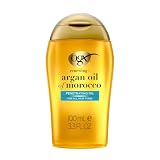
| OGX Renewing + Argan Oil of Morocco Penetrating Oil | $ Budget | 3.3 fl oz | Silicone-led serum | Dimethicone, Isopropyl Myristate, Dimethiconol | Damp, towel-dried hair, worked through to ends | 4.7 (20,087 reviews) | Check price (Affiliate link) |
| PURA D'OR Moroccan Argan Oil | $$ Mid | 4 fl oz | True oil (single-ingredient) | Argania Spinosa (Argan) Kernel Oil (100%, single ingredient) | Pre-wash treatment or a few drops on dry ends | 4.6 (30,878 reviews) | Check price (Affiliate link) |
Swipe the table to compare specs and ratings. The Buy column stays pinned.
How we chose these seven
We researched and compared; we did not use these oils. Every pick clears at least 1,000 Amazon ratings and a 4.0-star average, and the seven together carry more than 223,000 ratings, though pick 7’s share of that is a multi-use listing sold for skin and nails too. Where a pick has thin community backing, its section says so.
The method was to read what people with dry, frizzy hair say about oils and what they complain about afterwards, then check every formulation claim against the brand’s own published ingredient list rather than against a thread. Two Reddit sweeps returned 100 threads, but both ran against a degraded search index and came back with subreddit top-posts rather than query-matched ones, so we treat them as background. The evidence here sits on 22 threads pulled individually at full comment depth, 303 comments read line by line, across seven subreddits, and the split is worth stating: r/Haircare 5, r/finehair 4, r/HaircareScience 4, r/Sephora 4, r/longhair 2, r/curlyhair 2, r/CurlyHairCare 1, and none at all from r/Naturalhair. That evidence base is fine-to-wavy and salon-retail. Coily, type 4 and chemically relaxed hair uses oil differently, generously and as a way of sealing water in, and this page’s evidence is not about that hair. We did not evaluate colour-treated or bleached hair specifically either.
One finding from that reading belongs up here rather than buried. Buyers arrive at this category already suspicious of product recommendations, and our corpus suggests they are right to be. The poster who started one of the threads we read opened by saying they do not trust TikTok because most of the recommendations are sponsored. That same thread contains two near-identical raves for one brand, posted three minutes apart by different accounts, both carrying affiliate links; a second thread contains a matching pair roughly eighty minutes apart for a product that appears nowhere else in the 22 threads we read in full. We discarded all four. We also earn a commission on this page, which is why the picks are ordered by fit, no slot was bought, and every section names a downside its own owners raise.
Anything on this page about damage or wet-hair handling is pinned to the American Academy of Dermatology, not to a thread. Where a brand makes a claim we cannot check, such as a shine percentage or a strengthening benefit, we attribute it to the brand or leave it out.
First, which of the two things called “hair oil” do you want?
Two different products share the name. A finishing oil goes on clean hair at one to three drops and stays in. A pre-wash treatment goes on generously down the lengths before you shampoo, then washes out. Six of the seven picks are sold as finishing oils, one as a plain plant oil, and a few will do either job.
This is the confusion that produces the worst outcomes, and it turns up in the threads as a person holding two bottles and no instructions. The clearest example is an r/Haircare poster who had just bought two neat plant oils, dampened their hair with a spray bottle, worked them in at the scalp and asked the sub whether that was right, to which the second reply at 9 points said flatly that it does not belong there. The top reply, at 42 points, answered with a pre-wash routine you leave on and then wash out. Both answers are correct; they are answers to different questions, and nothing on either bottle told them which one they had bought. This page is about mid-lengths and ends; pre-wash scalp oiling is a different topic we do not cover.
Get this right and the price question answers itself. A commenter in r/finehair, comparing a drugstore argan oil against a salon one, put the rule better than any listicle: if you are doing a pre-shower oil on the lengths, either is fine and you should buy the cheaper one, and if you need an oil to go on clean hair, neither was their choice. Cheap oil for the job where it gets washed out. Better-formulated oil for the job where it stays in and has to disappear. What that rule does not settle is format, and for the wash-out job the format question flips: what you want soaking on your lengths is a plant oil, not a silicone blend, and buy-the-cheaper-one is about salon versus drugstore rather than about which format you pick. On this page that points at pick 7 for the pre-wash job, and at pick 6 as the cheapest way to try the finishing format.
If what your hair lacks is moisture rather than surface smoothness, an oil is the wrong purchase, and a deep conditioner or mask is the right one. The American Academy of Dermatology says to use conditioner after washing because it moisturises and detangles; it does not rule on oils either way. Reading the brands’ own ingredient lists, our own view is that oils and silicone serums sit on the outside of the hair and smooth the cuticle, which is a different job from putting moisture in.
Silicone serum or plant oil, and why most “argan oils” are mostly silicone
Most bottles sold as frizz oil are silicone blends carrying a little plant oil. We read the published ingredient lists for fifteen products across twelve brands. Thirteen are silicone-led blends. Only two contain no silicone: the K18 oil and the PURA D’OR argan oil. This is not an argument against silicones. It is what you are paying for.
Moroccanoil Treatment opens with cyclomethicone and dimethicone, with argan third. Verb Ghost Oil opens with three silicones in a row. Kérastase Elixir Ultime opens with isododecane, then dimethicone, then dimethiconol. OUAI, Davines OI Oil and Gisou all lead with silicones too, and the amika styling oil opens with isododecane before two silicones. The OGX drugstore bottle is the sharpest case: on the brand’s own current list it runs dimethicone, isopropyl myristate, dimethiconol, C12-15 alkyl benzoate, argan oil, fragrance. Argan is the fifth ingredient of six. Ingredient order tells you the sequence, never the percentage, so nobody can tell you from a label how much argan is in there. What the order does tell you is that the argan is not the main event.
Two of the fifteen lists carry added colourants as well. Moroccanoil Treatment and the Gisou oil both end on CI 26100 (Red 17) and CI 47000 (Yellow 11), which is worth knowing if your hair is blonde, grey or lightened, and if you mind what a tinted oil leaves on a towel or a pillowcase. Fragrance is the other thing the panels give away: almost every pick here is fragranced, and the lists say so themselves. Olaplex ends on citral, linalool, limonene, citronellol and hexyl cinnamal, K18 on cinnamal, hexyl cinnamal, limonene, linalool and rose ketones, and Verb’s tail is longer than either. If fragrance is the thing you have to avoid, pick 7 is the only one of the seven with none added.
There is a bonus example in the Garnier Fructis smoothing oil, where the brand’s own page carries a “no silicones” badge next to an ingredient list that opens with cyclopentasiloxane and dimethiconol. We did not shortlist it as a pick. We mention it because it is the clearest demonstration that front-of-pack language and the ingredient panel are answering to different departments.
The community has been saying this for years, and the two best-known statements of it are both old enough to need a date. A 2021 comment in r/HaircareScience, at 18 points, told a buyer that the OGX bottle was a silicone-heavy product with the argan far down the list. A 2019 r/HaircareScience thread on Moroccanoil drew two commenters calling it basically all silicones, and a third saying the same of the category; one of the two has a cosmetologist mother who bought it at trade price and still would not pay retail. Formulas move in five or seven years. That is why we went to the brand pages rather than repeating the threads, and the brand pages agree with them.
The community’s position is not that silicones are bad. It is that the silicones are why the light ones feel light. A commenter in r/CurlyHairCare put it as silicones being synthetic oils that do the same job better, used the same way. The most useful reply in an r/finehair thread was a refusal: asked for a natural-oil blend to use as a leave-in, a commenter answered at 5 points that ready-made serums use silicones precisely to make an “oil” light enough for fine hair, and that they doubted a natural oil existed that would do it. Another named Davines OI Oil as the lightest oil they had ever found and described it as one built on volatile silicones that evaporate, which is why they can never overdo it and also why they have to reapply. It is not one of our seven picks: the listing publishes no size, it was the most expensive bottle we looked at, and its own title cannot decide between coarse dry hair and all hair types.
The dissent is real and honest about being a minority. One commenter said their hair has never liked silicones and that they are in everything, which cuts out half the shelf. If that is you, this page has exactly two answers: the K18 oil for finishing, the PURA D’OR for pre-wash. Everything else here is a silicone blend, and pretending otherwise would be the easiest way to waste your money.
How much hair oil should you use, and where do you put it?
Use one to three drops of hair oil for shoulder-length hair, warmed between your palms until your hands look almost clean, then pressed in with flat hands from the mid-lengths down and brushed through. Never at the roots. Scale up for waist-length or thick hair, down if a single drop already reads as oily on you.
The brands and the threads agree more than you would expect. Olaplex says two to three drops. K18 says to start at one to three and build. Verb says two to three pumps on the mid-lengths and ends. Kérastase says one or two pumps and scopes it by hair type, one for fine hair and three to four for very long or thick. Gisou publishes a density table: one to two drops for fine, two to three for medium, three or more for thick. On the community side, most of the commenters in a single r/Sephora thread about the Olaplex oil said a little goes a long way, and the dose advice in the r/Haircare threads clusters in the same place. One r/finehair commenter’s version is the most precise: one drop applied at a time.
Two techniques do most of the work. The first is the palms test, described independently by commenters in two different subreddits: put the oil in your palm, rub until the oil has almost disappeared and your hands look barely coated, and only then touch your hair. If it pools in your palm you have too much. The second is the application itself, which the threads call praying hands: flat palms, gentle pressure, from the middle of the lengths down to the ends, then a brush or comb through to spread it. One commenter’s diagnosis of another’s greasy results was simply that the oil had not been brushed through after it dried.
One commenter in r/HaircareScience said one or two drops leaves their hair visibly oily and that they only use oil when they plan to keep it up until the next wash. In the same corpus, a commenter with thick, shoulder-blade-length 2b to 2c hair puts about a tablespoon through it while it is sopping wet and air-dries to a wave. Another says they use quite a lot and their hair loves it. Length, density and how oily your hair runs move the dose by an order of magnitude, which is why the honest instruction is a starting point plus a direction to adjust.
If you overdo it, you are not stuck. The rescue in the threads is to blot the excess with a microfibre towel and blow-dry cool. That also sits comfortably with the American Academy of Dermatology’s advice to wrap hair in a towel or t-shirt to absorb moisture gently rather than rubbing it dry.
How often is the question the threads answer less often, so here is the honest starting point: two or three uses a week with a finishing oil, more if your hair is long or coarse, less if one drop already reads as oily on you. Daily is where the buildup reports in our reading come from. And if an oil that used to work starts sitting on top and doing nothing, that is the signal to clarify and re-judge rather than to buy another bottle.
Wet, damp or dry? The threads split three ways
There is no consensus. In the clearest discussion we found, four commenters said dry only, five said wet or damp, and four said it depends on the oil. The workable rule came from that thread: moisture first, seal last. The heavier the oil, the more it wants damp hair.
The dry-only camp is led by the thread’s top comment at 27 points: dry only, last step, after heat. The wet camp is just as specific. One commenter puts Moroccanoil in while their hair is wet and says applying it dry leaves them flat and static-prone. Another says that on dry hair they need a lot of product to cover the lengths and it looks oily, so they wait for their hair to air-dry partway and apply to damp. The third camp splits by formula: coconut and olive oil on dry hair only, argan and jojoba on damp.
“Moisture first, seal last” is the sequencing that makes all three positions compatible. Water and conditioner go in first, then whatever seals the surface. The reason it matters is that oils sit on the outside of the hair, so putting one on before the moisture step works against you. The AAD is the source we would point to for the moisture half of that: its healthy-hair guidance is that conditioner is the step that moisturises and detangles, applied to the ends on fine or straight hair and along the whole length if your hair is dry or curly. The same page is the reason we would not brush hard through oiled wet hair: hair is delicate when wet, so a wide-tooth comb beats a brush, ends first.
One practical warning from the threads, which explains a lot of “this oil made me greasy” reports. If you apply on damp hair and then brush after it dries, you can drag the oil from the ends up toward the roots, and the grease you see at the top was put there by the brush. And the technique split runs straight through individual products: two owners of the Verb oil both love it, one using a single pump on wet hair in the shower on the lengths only, the other one tiny pump on dry hair.
Mapped onto the seven, the brands are more specific than the slogan is. Moroccanoil and the OGX bottle are the two whose own directions say damp, towel-dried hair and nothing else, so those go in before you dry. Olaplex, Verb and K18 are all sold for damp or dry, which is exactly why their owners split. Kérastase gives one or two pumps on mid-lengths and ends without saying which, and its owners report both. The PURA D’OR is the pre-wash bottle, or a couple of drops on dry ends.
1. Olaplex No.7 Bonding Oil: our top pick, and the one owners most often call light
Olaplex No.7 Bonding Oil
Best for: The finishing oil fine-haired owners most often call the lightest they have found, for damp or dry hair
Olaplex calls it a bonding oil; in practice it is a silicone-led finishing oil used at 2-3 drops a use for shine, smoothing and frizz control
- Frequently named the lightest oil owners have found for fine or easily-weighed-down hair, next to heavier salon serums
- A little goes far: 2-3 drops per use means a small bottle lasts many owners a year or more
- Doubles as a pre-heat-styling smoother and a post-styling shine finisher on damp or dry hair
- Olaplex markets it as a heat protectant, but at least one owner who likes the oil says not to rely on it as your sole heat protectant
- Price per ounce is high for the bottle size, offset only by how little product each use takes
- Not everyone finds it does much: a couple of owners call it fine but unremarkable and stick with other oils
(Affiliate link) · price may vary
The oil to buy if you want shine and frizz control with the smallest chance of looking greasy. It holds 4.7 stars across more than 61,000 Amazon ratings in the mid ($$) band, and Olaplex’s directions match what owners do with it: two to three drops on damp or dry hair.
Why it is our top pick
Across the threads we read at full depth, this is the oil that fine-haired and easily-weighed-down posters keep landing on, usually after something heavier disappointed them. In the r/finehair thread about a rival oil, a 24-point reply was that they find the Olaplex much, much lighter; another commenter in the same thread said it was the only oil they had found light enough. A separate r/finehair commenter preferred it because it is thinner and does not weigh their hair down. The most recent r/Sephora thread about it, from March, runs 60 comments, and its top reply at 22 points calls it a great finishing oil if you heat style, with a little going a long way. Most of the commenters in that one thread said the same thing about the amount, and the repeat-purchase reports run to a fourth and even a sixth bottle.
It is also the pick that survives the formula question without a caveat we have to hide. Olaplex’s own ingredient list opens with dimethicone, so this is a silicone-led serum with plant oils further down, not a plant oil. That is precisely why it behaves the way owners describe. If a silicone-free finisher is what you came for, skip to pick three.
Where it falls short
An r/Sephora commenter who rates the oil added that you should not use it as your sole heat protectant, and said they dislike that it is advertised as one. That is an owner’s opinion set against the brand’s own claim, and the claim is not unique to this bottle. Three of the picks here market 450°F heat protection on their listings: this one, the Verb oil and the K18 oil. We would treat none of the three as your only heat protectant, and if heat styling is the reason you are buying, read our heat protectant roundup and make that a separate decision. The brand’s copy also says the oil strengthens to reduce breakage, and its 77% figure is footnoted by Olaplex as a comparison against bleached hair with nothing on it. Those are the brand’s claims, scoped by the brand, and we are not restating them as findings.
Per ounce it is expensive for a 30 mL bottle. It also does not convert everyone: one commenter said they do not hate it but do not feel it does much, and another said they prefer drugstore oils and will not repurchase.
The downside that should change a decision, though, is what it is. Olaplex’s list opens with dimethicone, so what you are buying is a silicone-led serum, and pick 6 is a silicone-led serum at a small fraction of the price per ounce. If a light silicone finish is the whole of what you want, buy the OGX instead. What the extra money buys here is a better-made version of the same ingredient class, not a different one.
Olaplex · (Affiliate link)
2. VERB Ghost Oil: the most argued-about oil here
VERB Ghost Weightless Fine Hair Oil
Best for: The most argued-about frizz oil in owner threads, loved on damp lengths at one pump and returned by owners who used more
A weightless-marketed everyday oil most owners say only works in small amounts on damp lengths, not dry hair
- Few oils come up as often in owner conversations, and owners who like it use one pump on damp lengths and ends
- Owners who use it correctly, one pump on damp lengths and ends only, report a light, non-greasy finish
- Smooths frizz and adds shine without an overpowering scent, per repeat owners
- An entire large discussion thread in a fine-hair community calls it heavy and greasy, and the owners in that thread do not agree on why
- Most owners who like it use just one pump on damp lengths only, not the whole head and not dry hair
- Even careful owners say they still get some frizz back in high humidity
(Affiliate link) · price may vary
Best if you want the community’s default recommendation at a lower price than the salon bottles, and you are willing to be disciplined about the dose. It holds 4.6 stars across more than 11,000 ratings in the mid ($$) band, in a 2 oz bottle, larger than every salon bottle here except the Moroccanoil.
The case for it
Few products come up more often, and none is argued about more. It appears in nine of the 22 threads we read in full, five separate commenters recommend it in a single 41-comment r/Sephora thread, and it is the top comment of an r/finehair thread asking what to switch to. The praise is specific rather than vague: one commenter calls it the only oil that tamed all their frizz without weighing their hair down, another rotates it with two salon oils and likes all three. Verb’s directions say two to three pumps on damp or dry hair, and the listing calls it ideal for fine to medium hair.
The case against it, from owners with the hair it is sold for
An entire 99-point r/finehair thread exists because the poster found it made their hair heavy, oily and no better. Four commenters agreed it is simply heavy on fine hair, including one who found it sticky. Five diagnosed the failure as technique: one pump, on wet hair in the shower, lengths and ends only, is how the people who love it describe using it. And one commenter with wavy fine hair uses one tiny pump on dry hair and gets no grease at all, which is the exact opposite advice from the same thread. We report the split rather than resolving it, because the evidence does not resolve it.
The formula opens with cyclopentasiloxane, dimethiconol and dimethicone, so despite the plant oils in the marketing this is a silicone serum. One owner using it happily says they still get some frizz back on humid days.
VERB · (Affiliate link)
3. K18 Molecular Repair Hair Oil: the silicone-free finisher

K18 Molecular Repair Hair Oil
Best for: The silicone-free true oil for fine hair that wants shine without a silicone blend
K18 markets it as a molecular repair oil; the ingredient list itself is genuinely silicone-free, built on avocado, sunflower and squalane oils
- One of only two products in this lineup with a genuinely silicone-free ingredient list, evidenced from the brand's own INCI
- Owners consistently describe it as wildly lightweight, with 1-3 drops enough for most heads
- Works as a pre-styling treatment on towel-dried hair or as a dry-hair finisher
- The dispenser is hard to get product out of, even from an owner who otherwise loves the oil
- A tiny 0.34 fl oz bottle for the price, the smallest true oil on this list
- At least one fine-haired owner still found it heavy and greasy when applied to dry hair
(Affiliate link) · price may vary
This is the fine-hair pick for anyone avoiding silicones. It holds 4.3 stars across more than 1,300 ratings in the mid ($$) band. Of the fifteen ingredient lists we read, this is one of only two with no silicone anywhere on it.
K18 sells this as a “molecular repair” oil and its listing talks about repairing damage and reversing it inside the hair fibre. That is the brand’s language and its own claim, and we are quoting it rather than adopting it. What we can verify is the list: caprylyl caprylate, squalane, avocado oil and sunflower oil, and no silicones. That matters because it is the only route on this page to the light, non-greasy finish of a silicone serum without the silicones, and because it is the answer to the r/finehair commenter who doubted a natural oil could be light enough as a leave-in.
The community reports back up the weight claim. A commenter in that same r/finehair thread, at 14 points, switched to it from a heavier oil and called it wildly lightweight. The top comment of a wet-versus-dry thread, at 27 points, specified two drops. A third said a little goes a long way. Against that sits one careful dissent from a fine-haired owner who uses it on damp, towel-dried ends at one drop and finds it too heavy on dry hair. The brand’s own directions split the same way: one to three drops on towel-dried hair, or one to three drops on dry hair as a finisher.
The honest downsides are physical, not cosmetic. An owner who likes the oil and hates the bottle calls the dispenser terrible and hard to get enough product out of. At 0.34 fl oz this is by some distance the smallest bottle on this page, and by the same distance the highest price per ounce of the seven. And it carries the lowest star average of our picks, though a 4.3 across more than 1,300 ratings still clears our floor comfortably. One buying note: on our read a third-party seller held the buy box rather than Amazon itself, and counterfeits come up more than once in this category, so check the seller before you buy.
K18 · (Affiliate link)
4. Moroccanoil Treatment: the heavy classic, for thick or coarse hair

Moroccanoil Treatment
Best for: The heavy classic for thick, coarse or very frizzy hair that wants a substantial, smoothing oil
Moroccanoil's original Treatment; a lighter Treatment Light formula exists for fine hair, a different product from this one
- The best-known name in the category, with the deepest review base of any oil on this list
- Built for medium-to-thick or curly hair and smooths frizz in a single pass without extra product
- Works on damp hair before drying or on dry hair to tame flyaways and add shine
- Too heavy for fine hair: several owners say it starts looking greasy sooner than they'd like on finer strands
- The formula leads with silicones, and some owners feel that's a lot to pay for what is mostly a silicone blend
- The fine-hair answer in this line is the separate Treatment Light formula, not this bottle
(Affiliate link) · price may vary
The bottle that made the category, built for hair with enough weight to carry it. It holds 4.7 stars across more than 92,000 Amazon ratings, the deepest record on this page, at the top ($$$) of our price range. The brand scopes it to medium-to-thick or curly hair.
The people who love it in our threads have that hair. A curly commenter names it as the one that keeps their curls shiny and says they use a tiny bit to avoid buildup. Another calls it their “holy grail.” A third, at 9 points, describes it as a bit greasy until it absorbs and more hydrating than the silicone-based products they have used, which is interesting given the ingredient list and is a good illustration of how much finish differs from formula. Brand directions are a small amount on clean, towel-dried hair from mid-length to ends, or on dry hair for flyaways.
Fit is the first thing to weigh against that: several fine-haired commenters say it is too heavy and goes greasy sooner than they want, and one groups it with the Olaplex oil as too heavy for them. Then there is the formula-versus-price question, the oldest complaint in this category. Moroccanoil’s published list runs cyclomethicone, dimethicone, argan oil, and a Kérastase refugee in another thread said they refuse to pay a premium for a silicone blend even when it works.
Last is a naming trap worth more than it sounds. Moroccanoil sells a separate Treatment Light, and the community treats the two as different products, with several fine-haired commenters naming the Light version specifically as the one that works for them. The two brand-published lists are identical in ingredient order; the Light is a thinner, less pigmented version of the same idea, and the brand scopes the small Light bottle to fine or light-coloured hair. This card is the original Treatment. If you have fine hair and you want this brand, the other bottle is the one to look at, and we do not cover it here.
Moroccanoil · (Affiliate link)
5. Kérastase Elixir Ultime: the premium bottle, and the loudest price complaint

Kerastase Elixir Ultime L'Huile Originale Refillable Oil
Best for: The premium salon oil for shine and hydration, in a refillable glass bottle
Kerastase's own copy calls this an oil serum, underscoring how blurry the oil-versus-serum line really is
- A refillable bottle, unusual in this category, and a shine finish owners repeatedly praise
- Works on wet or dry hair for a quick shine boost during styling
- A loyal repeat-purchase following among owners who say nothing else compares for them
- A frizzy, wavy-to-curly owner found it went oily no matter how little she used
- Price and a reported reformulation are recurring complaints in owner discussions; exact figures vary by source and aren't repeated here
- Just over 1 fl oz per bottle, though the bottle refills
(Affiliate link) · price may vary
Buy this for the finish and the refillable glass bottle, not because it does something the cheaper picks cannot. It holds 4.6 stars across more than 6,000 ratings at the top ($$$) of our range, in a bottle just over 1 fl oz.
The one thing here you can check without trusting anybody is the bottle. Kérastase sells this as a refillable glass bottle with refills, which is the only pick on this page you top up rather than replace, and it is the honest reason to pay the premium. The brand’s own first line calls it an “elixir hair oil serum,” which tells you where it sits on the oil-versus-serum question. It has real defenders and they are not quiet. The top comment of an r/Sephora thread asking for favourite oils, at 31 points, was someone on their second bottle saying it works on wet or dry hair. In the largest oil thread in our corpus, a commenter at 12 points said there is nothing better. Another said they like it slightly more than our top pick and are splitting hairs. The only owner comparison of its kind in the corpus is a same-head side-by-side from r/finehair: a drop of this on one side, a drop of the Olaplex oil on the other, air-dried and photographed. Their read was that the Olaplex removed more frizz but sat slightly heavier, while this kept more volume and more frizz, and neither made them greasy. One person, one head, one session. We report it as their comparison, not as a test.
The complaints are about money and about change. The biggest thread we found on this oil, at 157 points, is entirely about price rises and a bottle redesign, and of the twenty comments we read, thirteen named a cheaper alternative. Every figure in that thread is the poster’s own unverified claim, so we are not repeating any of them. A commenter reported the reformulated version as watery, and the thread tally records a second reformulation complaint. And it does not suit everyone: the poster of a 2026 r/Haircare thread with frizzy, poofy wavy-to-curly hair said it made them look oily no matter how little they used.
For the label-readers: the ingredient list opens isododecane, dimethicone, dimethiconol, with camellia, corn and argan oils below, and the brand’s shine and smoothness figures are footnoted against unwashed hair and against a non-conditioning shampoo, which are very forgiving comparisons. As with pick 3, a third-party seller held the buy box on our read, so check the seller before you buy.
Kerastase · (Affiliate link)
6. OGX Argan Oil of Morocco Penetrating Oil: the budget bottle
OGX Renewing + Argan Oil of Morocco Penetrating Oil
Best for: The budget pick for daily use on all hair types, at a fraction of the salon price
OGX's own ingredient list leads with dimethicone; argan oil is the fifth of six ingredients, a finishing note rather than the main event
- The lowest price per ounce of any pick on this list, with a large, well-reviewed following
- A lightweight, non-greasy feel that owners say works for daily use across hair types
- Widely available and easy to replace, useful for a first oil to try
- On the brand's own ingredient list, two of the first three ingredients are silicones and argan oil sits fifth of six, so this is a silicone-led serum with argan in it, not an argan oil
- A couple of owners report buildup with prolonged use
- Some owners say OGX products in general tend to mat at the back of the head
(Affiliate link) · price may vary
The one to buy first if you have never used an oil and do not want to spend to find out whether you like the format. It holds 4.7 stars across more than 20,000 ratings in the budget ($) band, and at 3.3 fl oz it is the lowest price per ounce of the seven.
What the ingredient list actually says
OGX publishes six ingredients: dimethicone, isopropyl myristate, dimethiconol, C12-15 alkyl benzoate, argan oil, fragrance. Argan is fifth of six. This is a silicone serum with argan in it, sold under argan’s name, and the community worked that out years ago; a 2021 r/HaircareScience comment at 18 points told a buyer exactly that about this bottle. Ingredient order does not give you a percentage and we are not going to pretend it does. It does tell you that if you are buying this for the argan, you are buying the wrong thing, and if you are buying it for a light silicone finish at a fraction of the salon price, you are buying exactly the right thing.
That is not a dismissal, because the owners are happy. A fine, wavy-haired commenter in the same thread says it does not make their hair greasy, and two more fine-haired owners report no problems. One commenter who left Kérastase over its price switched to this and found a similar texture. It is also the cheapest way to try the finishing format: a fine-haired commenter comparing it against a salon bottle said that for an oil you are going to wash out, take the cheap one, and the same logic holds for a finisher you are not yet sure you will like. For the pre-wash job itself we would point you at pick 7, which is a plant oil rather than a silicone blend.
Buildup comes up more than once with prolonged use, including from an owner who used it for months on their own hair and on extensions. One commenter says OGX products in general mat at the back of their head no matter how they rinse. OGX also sells an “Extra Penetrating” version of this oil at the same price and size, scoped by the brand to coarser and colour-treated hair; we link the standard one because the argan-fifth-of-six list above belongs to it, where the Extra’s own list runs cyclopentasiloxane, cyclotetrasiloxane, dimethiconol, with argan fourth.
OGX · (Affiliate link)
7. PURA D’OR Moroccan Argan Oil: the true plant oil, for the pre-wash job

PURA D'OR Moroccan Argan Oil
Best for: The deliberately silicone-free true plant oil, best as a pre-wash treatment or a couple of drops on dry ends
A genuine single-ingredient cold-pressed argan oil, with no silicones or added fragrance in the formula
- The only single-ingredient plant oil on this list: just cold-pressed argan oil, nothing else
- The lowest price per ounce among the true oils, with a large, well-established review base
- Suits the pre-wash job: applied generously to the lengths, left on, then washed out, it needs none of the weightlessness a finishing oil needs
- As a neat plant oil, it's heavy as a leave-in finisher; used generously it can leave hair looking wet or clumped, the community's most common self-inflicted mistake with oils like this
- The listing says no synthetic fragrances, so it smells of raw argan rather than of a salon; that is also its one clear advantage for anyone avoiding fragranced products
- Used generously as a pre-wash treatment, it needs a real wash to come back out
(Affiliate link) · price may vary
This is the deliberate silicone-free option, and it is here for the pre-wash job rather than as a light finisher. It holds 4.6 stars across more than 30,000 ratings in the mid ($$) band, in the largest bottle on this page at 4 fl oz. PURA D’OR’s published list is a single cold-pressed argan oil and nothing else.
Be clear about the evidence, because it is thinner than every other card here. We found no mention of it in the threads we read, and a site:reddit.com re-probe turned up only off-target mentions: someone in a skincare sub who uses it on their hair and thinks it is the real thing, and someone in a vegan-beauty sub who uses it to take off eye makeup. Nothing about frizz. Its 30,000-plus ratings also belong to a multi-use listing the brand sells for face, body, nails and beard as well as hair, so treat the number as a record for the oil rather than for this job. It earns its slot on that record and on the category evidence around it, which is consistent and unflattering: the most detailed owner trial log we found, covering ten oils, opens its argan entry with “HEAVY. STINKY.” and reports that a single dot made no difference. An r/HaircareScience commenter told a poster who had failed with grocery-store oils to use products formulated for hair instead. Another said one or two drops already reads as visibly oily on them. And the r/finehair refusal we quoted earlier said outright that they doubted any natural oil was light enough to leave in fine hair.
So do not buy this as your light one. Buy it if you want the pre-wash treatment, where heaviness is not a fault because the whole point is that it comes off in the wash, or for a couple of drops on dry ends to smooth the look of split ends between washes. The brand suggests four to five drops on the ends and two or three uses a week. The listing says no synthetic fragrances, so it smells of raw argan rather than of a salon, which is also its one clear advantage over every other pick here if fragrance is what you are avoiding. Used generously it needs a real wash with shampoo to come back out.
PURA D'OR · (Affiliate link)
If the oil keeps sitting on top and doing nothing
Before you conclude your hair is low porosity, rule out buildup. Four separate commenters in one r/curlyhair thread told a poster certain of their porosity that the real cause was product residue or hard water. That is what several owners found rather than a mechanism we can source, so clarify first and then re-judge.
The poster’s complaint was that everything sits on top, weighs their hair down and looks greasy; the replies pointed out that undamaged low-porosity hair should not be that dry in the first place, and that low-porosity hair builds up easily, which makes it harder still for anything to absorb. If that sounds like your hair, a pass with a clarifying shampoo is a cheaper experiment than another oil. If the problem persists after a proper reset, our hair porosity guide covers what porosity is and how to work out yours, and we would rather point you there than rebuild it badly here.
Where an oil is the wrong tool
Sometimes frizz is not an oil problem. Wavy and curly hair often does better with a lightweight cream or leave-in than with anything oily, and one commenter in our corpus says no oil or serum has ever worked on their frizz at all. An oil smooths the surface; it does not add moisture.
The most useful statement of the limit came from the top comment of that 99-point r/finehair thread, at 53 points, from someone with waist-length hair who uses oil and still says it plainly: oil is heavy, they do not believe a lightweight hair oil exists, and what it does is smooth the cuticle and make damage less visible. That is the right register for this whole category. If your hair is dry rather than frizzy, the fix is upstream: the AAD’s damage guidance is as simple as using conditioner after every shampoo, plus air-drying where you can and the lowest workable heat setting. A leave-in conditioner does the between-washes job an oil cannot, and if your hair is dry at the ends rather than frizzy on the surface, the honest answer is a better rinse-out conditioner for dry hair before another bottle of oil. Several commenters who gave up on oils for frizz landed on leave-ins and smoothing creams instead.