


Our top pick is the Wet Brush Original Detangler, the flexible everyday brush that eases wet or dry knots on almost any hair without the yank. The rest of this page is really about one idea: there is no single best hair brush, only the best brush for your hair and the one job you need done.
That is not a cop-out, it is the finding. “Best hair brush” is six different questions wearing one search box. The person untangling a four-year-old’s hair, the fine-haired reader chasing shine, and the curly person clumping ringlets in the shower all need a different tool, and the wrong one does real damage. So before the picks, here is the honest first rule that most brush roundups skip: a lot of the time the best move is to reach for a comb, or to replace the brush you already own.
The American Academy of Dermatology is blunt about it. Hair is fragile when it is wet, so the AAD says to detangle wet hair with a wide-tooth comb, not a brush, working the ends first. It also lists brushing wet hair, and the old “100 strokes a day” habit, among the ten things that damage hair: “Hair never needs 100 brush strokes a day. That’s a myth.” An affiliate page that tells you to sometimes buy less brush is trying to earn your trust, not just your click. We researched these six against 60 Reddit threads and 348,000-plus Amazon ratings; we did not test them, and we say so wherever the evidence is thin.
| Product | Price | Type | Bristles | Use | Hair type | Rating | Buy |
|---|---|---|---|---|---|---|---|
| Wet Brush Original Detangler Hair Brush Our pick | $ Budget | Detangling brush | IntelliFlex flexible nylon | Wet or dry | All textures | 4.7 (78,746 reviews) | Check price (Affiliate link) |
| Crave Naturals Glide Thru Detangling Brush | $ Budget | Detangling brush | Firm cone-shaped nylon | Wet or dry | — | 4.4 (102,843 reviews) | Check price (Affiliate link) |
| Tangle Teezer Ultimate Detangler Brush | $ Budget | Detangling and smoothing brush | — | Wet or dry | — | 4.6 (60,321 reviews) | Check price (Affiliate link) |
| Belula 100% Boar Bristle Hair Brush | $$ Mid | Boar bristle brush | 100% boar | — | — | 4.4 (13,318 reviews) | Check price (Affiliate link) |
| Denman D3 7-Row Styling Brush | $$ Mid | Curl-defining styling brush | — | — | — | 4.6 (80,117 reviews) | Check price (Affiliate link) |
| Conair Ultra-Wide Paddle Hair Brush | $ Budget | Cushioned paddle brush | Ball-tipped nylon | — | — | 4.6 (14,504 reviews) | Check price (Affiliate link) |
Swipe the table to compare specs and ratings. The Buy column stays pinned.
How we picked, and what we did not do
We researched and compared; we did not test. Every pick clears a floor of at least 1,000 Amazon ratings and a 4.0-star average, every “Buy” link is an affiliate redirect we label as one, and no product bought its way onto the list.
The lowest-reviewed pick here still carries more than 13,000 ratings, and the deepest carries more than 100,000. That review depth is doing a lot of the work, because a brush is a simple object and the community talks about categories (“a boar brush,” “a Denman”) more than model numbers. So the method was to read what people actually reach for and complain about across r/Hair, r/Haircare, r/curlyhair, r/longhair, r/BuyItForLife and a few others, group the picks by the job each brush is genuinely good at, and pin every health or damage claim to the AAD rather than to a Reddit post. Where a slot rests on the Amazon record more than on community endorsement, the section says so plainly.
The four things that decide which brush you need
Your hair type paired with one job, whether the hair is wet or dry, whether the bristle tips are worn, and whether a brush is even the right tool. Wattage-style spec sheets do not exist for brushes, so these four judgments are the whole decision.
Match the brush to one job, not to “good hair”
Ask what you need the brush to do, then buy for that. Detangling wet knots, smoothing dry frizz, carrying scalp oils down fine hair for shine, defining curls, and getting through a thick or long head fast are five different jobs, and no brush is best at all of them. The clearest version of this came from a reader who had used one shower brush for years and finally asked whether pairing two brushes, one for wet and one for dry, would improve things. It would, and that is the point: most people are under-tooled, not badly tooled.
Wet or dry changes the answer, and the AAD has a rule
On wet hair, the gentlest tool usually wins, and that means a comb, not a brush. Wet hair stretches and snaps more easily, which is why the AAD’s guidance is to use a wide-tooth comb instead of a brush on wet hair and to comb the ends first, then work higher. An inexpensive drugstore wide-tooth comb is the honest answer for wet detangling, and we would rather point you to one we do not sell than push a brush at a job a comb does more gently. If you are going to brush wet anyway, use the most flexible detangler you own, never a stiff one. Curly hair is the exception that proves it: the community brushes curls damp, in the shower, over conditioner or leave-in, which keeps the hair slippery and supported. A slippery leave-in conditioner does more for a painless detangle than any brush upgrade. A parent of a curly six-year-old was told the same thing at a Lush counter, by someone not selling anything: comb it, do not over-wet it, and skip the stiff detangling brush.
Worn ball-tipped bristles are a hidden cause of breakage
If your brush has little balls on the bristle tips and some have gone missing, it is probably snagging. Those plastic tips protect the scalp when new, but they crack and fall off with use, and a bare bristle end catches and rips. One much-upvoted r/Haircare poster who recovered from mystery breakage put it simply while recommending a boar brush: get “the ones without the balls on the ends” because they will not tear the hair. If you cannot remember when you bought your brush, that is a finding.
Sometimes the honest answer is “not a brush”
A solid mat, very fragile wet hair, or tightly coiled texture can be a case for fingers, a comb, or a pick instead. One parent fought an avocado-pit-sized mat with baby oil, three conditioners, four brushes “including a boar bristle,” a pick, and a literal fork. A brush is a maintenance tool, not a rescue tool, and forcing one through a bad tangle is how hair comes out in the brush rather than the knot.
1. Wet Brush Original Detangler: the one to own if you own one
Wet Brush Original Detangler Hair Brush
Best for: The universal everyday detangler: flexible IntelliFlex bristles bend through wet or dry knots on almost any hair type without the yank
Ultra-flexible IntelliFlex bristles that give way around a knot instead of ripping through it, wet or dry
- The default painless detangler for a reason: the bristles flex around knots instead of snapping through them, on wet or dry hair
- Works across straight, wavy, curly, thick and fine hair, which is why it is the safe pick if one brush has to cover a whole household
- Cheap enough (budget $ price) to keep one in the shower and one in a bag without a second thought
- It detangles but barely styles: the soft bristles will not smooth, add tension, or shape hair the way a paddle or boar brush does
- The fine ball-tipped bristles can splay or shed after months of heavy use, and some owners report the tips popping off
- Too soft to bite through very thick or tightly coiled hair in one pass; those textures still need sectioning
(Affiliate link) · price may vary
This is the brush we would hand someone who asked once and did not want to think about it again. The Original Detangler holds 4.7 stars across more than 77,000 Amazon ratings in the budget ($) band, and its flexible IntelliFlex bristles are the reason: they bend around a knot instead of dragging through it, on wet or dry hair, across straight, wavy, curly, thick and fine textures.
Why we recommend it
It is the default answer for a reason. Across the threads we read it was the brush people describe as “my only hairbrush for years,” the one that lives in the shower and gets handed to the kids. On curly hair, where soaking-wet detangling is unavoidable, one r/curlyhair poster reached for a wet brush specifically because their hair was “unmanageable” otherwise. It is not doing anything clever. It is a soft, forgiving brush that fails gently, which is exactly what you want touching wet hair.
Where it falls short
It detangles, and that is close to all it does. The soft bristles will not smooth, add tension, or shape hair the way a paddle or a boar brush will, so it is a companion to a styling brush rather than a replacement for one. It is also treated as disposable for a real reason: the bristles can splay with heavy use and the ball tips can pop off, at which point it starts snagging and it is time to replace it. And on very thick or tightly coiled hair it is too soft to bite through in one pass, so those textures still need sectioning.
Wet Brush · (Affiliate link)
2. Crave Naturals Glide Thru: the budget detangler with the deepest record
Crave Naturals Glide Thru Detangling Brush
Best for: The budget detangler with the deepest track record: a cone-shaped bristle head that eases knots on kids and tender-headed adults
Firm cone-shaped bristles that separate and glide through knots from the outside in, on wet or dry hair
- The deepest review record of any brush here, over 100,000 ratings, a lot of them from parents detangling kids' hair without the tears
- Firmer bristles than a Wet Brush, so it keeps its shape and clears knots in fewer passes
- Budget ($) price in a slim, travel-friendly body
- Those firmer bristles feel scratchier on a sensitive scalp than the softest detanglers; a light hand helps
- No give at the base, so on very thick or matted hair it can tug where a more flexible brush would glide
- It is a detangler only: no smoothing, no styling, no oil distribution
(Affiliate link) · price may vary
For people detangling kids, tender heads, or their own knots on a budget. The Glide Thru carries the deepest review record on this page, 4.4 stars across more than 102,000 Amazon ratings, and its cone-shaped bristle head is built to separate and ease knots from the outside in, on wet or dry hair, for budget ($) money.
The case for it is the case against tears. The pain point behind half the “help with my kid’s hair” threads is a child who hates having their hair done and a parent who is scared of ripping it out, and this is the brush that community keeps circling for exactly that. One r/curlyhair poster listed it plainly in their routine: condition, then “detangle with Crave Naturals brush.” It keeps its shape better than the softest detanglers, so it clears knots in fewer passes. One honest caveat on the badge: at these prices it is not literally the cheapest brush here, since the Wet Brush runs about a dollar less and the Conair paddle less still. It earns the budget slot on the rare mix of a low price and the deepest review record on this page, pointed squarely at the one job budget shoppers most need.
The trade-off is stiffness. Those firmer bristles that clear knots efficiently also feel scratchier on a sensitive scalp than a Wet Brush does, so a light hand helps, and there is no give at the base, so on a genuinely matted section it can tug where a more flexible brush would glide. Like the Wet Brush, it is a detangler and nothing else: no smoothing, no shine, no styling.
Crave Naturals · (Affiliate link)
3. Tangle Teezer Ultimate Detangler: for smoothing dry hair in a pass
Tangle Teezer Ultimate Detangler Brush
Best for: The dry-smoothing detangler: two-tier teeth that pull out knots and lay the cuticle flat for less frizz in one pass
Patented two-tier teeth (long teeth detangle, short teeth smooth) for frizz control on wet or dry hair
- The two-length teeth do two jobs at once: the long teeth loosen knots while the short teeth smooth the surface, so dry hair looks less frizzy in a pass
- The palm-held shape gives more control and downforce than a handled brush for a quick smooth-out
- Works on wet or dry hair and doubles as a product-distribution brush in the shower
- No handle: the palm-held shape is polarizing, and wet or soapy hands lose their grip on it
- The compact head is slow going on very long or very thick hair next to a wide paddle
- Priced above the plain detanglers for what is still, mechanically, a detangling brush
(Affiliate link) · price may vary
Reach for this when the job is dry-hair frizz, not just knots. The Ultimate Detangler holds 4.6 stars across more than 60,000 ratings in the budget ($) band, and its two-tier teeth are what set it apart: the long teeth loosen tangles while the short teeth smooth the surface, so a pass over dry hair looks calmer, not just untangled.
It was the single most-named brush across our general threads, and the curly community leans on it hard too, brush-styling leave-in through wet curls with it in the shower. It doubles as a product-distribution brush, and its palm-held shape gives more downward control than a handled brush for a quick smooth-out. The recurring complaints are honest and worth knowing. It has no handle, which people either love or find awkward, and wet or soapy hands lose their grip on it. On dry hair some users soak it first to cut the drag. And it still sheds hair: one poster brushing twice a day worried about “60 hairs a day,” which is a good moment to remember that most of the hair you see in a brush is hair that had already shed, not hair the brush is pulling out.
Tangle Teezer · (Affiliate link)
4. Belula 100% Boar Bristle Brush: shine for fine hair, not detangling
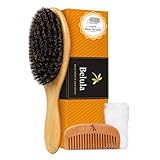
Belula 100% Boar Bristle Hair Brush
Best for: The shine-and-oil brush for fine or thin hair: soft boar bristles that carry the scalp's own oils down the strand
100% boar bristles that distribute the scalp's natural oils to add shine and cut static on fine to medium hair
- Soft boar bristles move the scalp's own oil down the hair, which adds shine and cuts static without a product
- Gentle enough for fine, thin hair and sensitive scalps, where stiff nylon pins feel harsh
- Arrives as a set with a comb, headband and travel bag at a mid ($$) price
- Not a detangler, and the maker says so outright: the short, soft bristles cannot work through a knot
- Those same short bristles only reach the surface of thick or long hair, so you have to brush in small sections
- Boar brushes shed a few bristles over time, and some owners find the set's extras flimsy
(Affiliate link) · price may vary
Best if your hair is fine or thin and the goal is shine, not knots. The Belula is a 100% boar-bristle brush at 4.4 stars across more than 13,000 ratings, mid ($$) money, and its soft bristles do one cosmetic job well: they carry the scalp’s own oils down the strand, which adds shine and, for some owners, cuts static without a product (others with fine, oily hair report the opposite; our static hair guide weighs both). That is an appearance effect, not a growth treatment, whatever the listings imply.
Fine and thin hair is where boar earns its keep, because the soft bristles glide where stiff nylon pins would feel harsh, and the same oil-distribution is why one r/Haircare poster who switched from a decade-old plastic brush described their hair two weeks later as shinier and less frizzy, with a less itchy scalp. It arrives as a set with a comb, headband and travel bag.
Be clear about what it cannot do, because this is where people waste money. It is not a detangler, and the maker says so outright: the short, soft bristles cannot work through a knot, which is exactly why the parent with the avocado-pit-sized mat got nowhere with one. Force it and you get the r/curlyhair account of a poster who had a boar brush dragged down their own curls “with pure force” until it stuck and had to be worked out. On thick or long hair the bristles only reach the surface, so you brush in small sections, and boar brushes shed a few bristles over time.
Belula · (Affiliate link)
5. Denman D3: the curl-definer the curly community reaches for
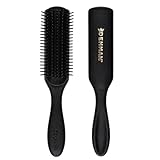
Denman D3 7-Row Styling Brush
Best for: The curl-definer: seven rows of round-ended pins that clump and shape curls and coils, usually over leave-in in the shower
Seven rows of round-ended nylon pins in an anti-static rubber pad for defining curls and smoothing
- The curly community's reference brush for turning separated strands into defined, clumped curls, usually worked through leave-in in the shower
- Rows of pins pull out, so the brush can be softened for looser or more fragile curl patterns
- Round-ended pins and an anti-static pad glide without the static a plastic paddle throws
- It defines by adding tension, which costs volume: flat roots and, on coily hair, more shrinkage are the recurring owner complaints
- It smooths and clumps but is not a gentle wet-detangler for knots; the knots come out first, with something else
- Aggressive with every row in: on some curl types it thins the clumps or adds frizz, which is why owners remove rows
(Affiliate link) · price may vary
If you have curls or coils and you want defined, clumped ringlets, this is the reference brush. The Denman D3 holds 4.6 stars across nearly 80,000 ratings, mid ($$) money, and its seven rows of round-ended pins in an anti-static pad are made to gather separated strands into curls, usually worked through leave-in on soaking-wet hair in the shower.
The enthusiasm in r/curlyhair is hard to overstate. First-time posts read like conversions (“so incredibly impressed,” “I think I’m in love”), and one long-running favourite captures the feeling exactly: every time this person uses it in the shower they think “this is going to be a frizzy disaster” and end up wrong. It is a styling brush, and a good one.
It is also the pick with the most honest caveats, so here they are. It defines by adding tension, which can flatten volume: one poster found that simply raking product through with their fingers gave more body than the Denman did. A vocal minority quits styling brushes altogether and reports their hair is happier for it. Many curlies soften the brush by pulling out a few rows of pins, which tells you the full seven can be aggressive on finer or looser patterns. And it is not a gentle wet-detangler for knots: the knots come out first, with fingers or a comb, and then the Denman shapes what is left. If your curls thrive on a lighter touch, a good diffuser and your hands may matter more than any brush. The curly-specific question, which brush for which job and whether to brush at all, has its own page: our curly hair brush roundup.
Denman · (Affiliate link)
6. Conair Ultra-Wide Paddle: the cheap big brush for length and bulk

Conair Ultra-Wide Paddle Hair Brush
Best for: The big everyday paddle for long or thick hair: a wide cushioned head that covers more hair per stroke
Extra-wide cushioned paddle with ball-tipped bristles to smooth and detangle long, thick hair fast
- The widest, fastest everyday brush here: the oversized paddle covers long or thick hair in fewer strokes
- Ball-tipped bristles and a flexible cushion base reduce snagging on dry hair
- The cheapest pick on the page by a wide margin (budget $ price), and hard to out-spend for plain daily brushing
- Build matches the price: ball tips can work loose and bristles can pull out of the cushion over time
- The wide-spaced bristles skip over fine or short hair; this is a brush for length and bulk, not fine detangling
- Plain nylon on dry hair throws static, especially in winter
(Affiliate link) · price may vary
For long or thick dry hair that you just want smoothed in fewer strokes. The Conair Ultra-Wide Paddle is the cheapest pick here by a wide margin, budget ($) money at 4.6 stars across more than 14,000 ratings, and its oversized cushioned head with ball-tipped bristles covers more hair per pass than any other brush on this list.
This is the everyday workhorse for people with a lot of hair to get through. Paddle brushes are the default first brush most people own, and Conair-brand brushes have a quiet reputation for lasting: one detailed r/Haircare write-up noted their brushes are “all Conair brand from Target” and the oldest was “hitting 6 years.” Treat that as one person’s experience rather than a durability guarantee, because the honest read on this pick is that the build matches the price. Ball tips can work loose and bristles can pull out of the cushion over time, the wide-spaced bristles skip over fine or short hair so this is a brush for length and bulk rather than fine detangling, and plain nylon on dry hair throws static, especially in winter. At this price, it is a brush to use and replace, not to keep for a decade.
Conair · (Affiliate link)
Is a boar bristle brush worth it, and does the price matter?
Worth it for shine on fine-to-medium hair, not for detangling, and no, you usually do not need the expensive one. Boar bristles add shine by moving your scalp’s oils down the hair, a cosmetic effect that a $7 brush delivers about as well as a $70 one.
This is the question behind a lot of boar-brush searches, and one r/Hair poster asked it perfectly: they had seen “one at walmart for like $7 but another i saw online was $70” and wanted to know if it “rlly” mattered. For the oil-distribution job, the honest answer is that it mostly does not. Bristle quality and density vary, and a genuine luxury brush like a Mason Pearson is a lovely object that will outlive you, but it is not a different result for most heads of hair, which is why the premium boar brushes are not picks here. The broader pattern showed up again and again in the budget threads: one of the highest-scoring curly posts we read got a full head of ringlets using “a knock off Denman at Walmart, and paddle brush” for four dollars, and concluded that expensive tools are pushed on people who do not need them. Buy boar for the shine, buy cheap, and skip it entirely if what you actually need is to get knots out.
How to brush your hair, and the 100-strokes myth
Brush to style, not to “condition,” work from the ends up in sections, and do it on dry or barely-damp hair rather than soaking wet. The single most useful correction here is that hair does not need 100 strokes a day, and never did.
That myth has a real cost, because over-brushing is mechanical wear. The AAD is direct: “Hair never needs 100 brush strokes a day. That’s a myth,” and it groups brushing wet hair and tugging-to-style alongside heat and tight ponytails as habits that break hair. The community has arrived at the same technique from the other direction: detangle from the bottom up, in sections, so a knot slides out the end instead of compounding toward the scalp. As one parent of thick, curly-haired kid put it, they go “bottom to top in sections” and would be “nearly bald” if they did not. If you brush wet, keep it to a wide-tooth comb, or at least the most flexible detangler you own, and for curls, do it damp and slippery with conditioner in.
Cleaning your brush, and when to replace it
Pull the shed hair out every few uses, wash the brush every few weeks (weekly if you use a lot of product, per Healthline), and replace it when the bristles bend, shed their tips, or you simply cannot remember buying it. A grey, linty film building up between the bristles is normal shed skin, oil and product, not a sign anything is wrong with you.
This is the most under-served corner of the whole topic. Thread after thread is just a photo of a gunky brush and a worried “what is this stuff,” and one person spent “about an hour” clearing theirs with tweezers. The buildup is ordinary: remove the trapped hair with your fingers or a rat-tail comb, then swish the brush in warm water with a little shampoo, tip-side down so water does not sit in a cushion pad, and let it dry bristles-down. Which brushes can soak and which cannot, and what the grey fuzz actually is, are in our full guide to cleaning hair brushes. The bigger lesson is the one that opened this page. People keep brushes for a decade without realising they wear out, and more than one poster described a genuine improvement in shine and frizz after simply replacing an old brush. If yours has splayed bristles or missing ball tips, the brush is the problem, and a new budget one costs less than a coffee.
Round and blow-dry brushes are a different job
A round brush is for shaping and volume during a blow-dry, not for everyday detangling, and the all-in-one hot round-brush dryers are a separate tool with their own risks. If you want a smooth, voluminous blowout, that is a styling job that belongs with your dryer, not your everyday brush.
We left round brushes off this list on purpose, because “best hair brush” is an everyday-brush search and round brushes are a styling accessory. They earn their place at the blow-dryer: one detailed r/Haircare journey called switching back to a round blow-dry brush “the biggest game changer,” while being honest that it is a hassle (“I HATE using it, my arms get tired”). The same writer warned off the big one-step hot round-brush dryers as running too hot and doing damage. If a blowout is your goal, start with the right dryer and technique and a heat protectant; the round brush is the last piece, not the first.