Static is an electric charge your hair picks up from rubbing against a brush, hat, scarf or pillow. In dry air a dry strand sheds it slowly, so it builds up, and strands carrying the same charge push each other apart. The quick fix is a little water. The lasting fix is a light conditioning layer on the lengths and moister air at home.
An r/finehair poster described it as “it’s so staticky in just sticks my clothes, and it gets to the point where I can’t wear my hair down and this only happens during winter”. Another wrote: “I haven’t changed my hair routine but it’s so much worse than before.” We read 298 Reddit threads from static-hair searches, 96 of them about static itself, 15 opened in full, mostly r/finehair and r/HaircareScience; the archive search was patchy, so treat the counts as a sample.
This page first checks that what you have is static, then explains in plain English why hair holds a charge, sorts the causes by when the static shows up, and separates the fixes that work for a short while from the ones that cut how often it returns. Every product mention names a downside.
Static or frizz? A test you can run
Hold your hand above your head. If strands lift toward it, cling to your clothes or face, or crackle, that points to static: it is worst in cold, dry air and eases in humid weather. Frizz is a puffy texture that grows in humid air. The two can overlap, so treat the humidity pattern as a clue, not a verdict.
A 1978 cosmetic-science paper states that “For flyaway, static charge is the determining factor”, and that as humidity rises, flyaway falls. Frizz goes the other way, as Lab Muffin’s frizz explainer covers, and one study suggests humidity may change how frizzy curly hair feels to the touch, through changes in friction.
Posters know the difference. Of conditioners, one r/finehair poster wrote: “They help with frizz but not static. Not even hairdressers seem to know these two things are different.” If yours puffs up on humid days, start with our oils for dry, frizzy hair. If it feels like straw all year, read why your hair is so dry.
Why hair holds a charge, in plain English
Rubbing two different materials moves charge between them, and dry hair lets it leak away only slowly. Research names plastic combs, hands and latex balloons among the things that charge hair. Cosmetic chemists at The Beauty Brains say that on dry hair, the electrons “just kind of sit there”.
Water lets it out: hair insulates, but a materials-science abstract reports a “drastic reduction in resistivity” in wet hair. Physicist Ivana Dimitrova says that in humid months water molecules in the air redistribute the extra charges.
Strands carrying the same charge then push each other apart, as The Beauty Brains explain. No source we found gives a humidity figure at which static begins, so we will not invent one. Which way the charge runs depends on what your hair rubs against: both surfaces end up with charges “of opposite sign and equal in magnitude”.
| When it happens | The likely cause to check | What to do |
|---|---|---|
| Every winter, or when the heating goes on | Dry heated air | Lasting fixes 1 and 2 |
| After moving somewhere dry, or in air conditioning | Dry air | Lasting fixes 1 and 2 |
| After brushing | A plastic brush | Lasting fix 3 |
| After washing | A high-cleansing shampoo without enough conditioner | Lasting fix 2 |
| On day two | What conditioner left on wash day has worn off | A little leave-in on the ends the night before |
| After blow-drying or straightening | Heat, then brushing; posters disagree on which matters | Lasting fix 5 |
| From a hat, scarf or sweater | Wool and synthetic fabrics | Lasting fix 4 |
| After a product or routine change | A change in what coats the hair, either way | Lasting fix 2 |
| After a haircut | We found no evidence a cut causes static | Check what else changed |
| After dyeing | Evidence points both ways | Lasting fix 2 |
A dermatology review backs the after-washing row: high-cleansing shampoos “increase chargeability”, so a clarifying wash counts too; follow either with conditioner on the lengths. Day two is different: conditioners “temporarily repair” the surface, and the layer wears off. One poster: “The static is not to bad on the day I wash my hair, but it’s terrible on day 2.” Another noticed it before the shower was over: “Even when half my hair is wet from the shower the part that’s dry is already full of static.”
A haircut can coincide with colder weather, a new brush or a salon blow-dry, so check whether any of those changed too. For hard water, see our dry-hair guide.
Fix it right now
Short-term fixes; posters say they fade fast:
- Water. Damp hands or a mist on the lengths; one commenter said a mineral-water spray “shuts down the static.”
- A dryer sheet, over the hair or through your brush. It is a laundry product, not made for hair. Named most often in our sample, and Healthline lists it, but several posters say it wears off within minutes.
- A metal or wooden comb in place of a plastic one, which helps some: “Wooden combs do the trick,” wrote one commenter.
- A small amount of leave-in, or a drop of oil on the ends; start small and follow the label. A few posters say oil made theirs worse, so test it on a quiet day.
- Static Guard on the brush works for some posters, but it is a fabric spray, not made for hair; read the label.
- A light hairspray, for some: “I find a little spritz of hairspray is the easiest thing for static,” said one; another found “it wouldnt really work for long”.
One poster put the limit of dryer sheets and hand lotion plainly: “These help for about 30 seconds then the static is back.”
Stop it coming back
Add moisture to the air and a light conditioning layer to the hair, then cut friction.
1. Add moisture to the air at home and overnight. Physicist Sebastian Deffner names a humidifier as the everyday way to cut charge build-up. “Using a humidifier helps reduce static in the air,” ran the top r/finehair answer. Its limit, from the same thread: “I could certainly add a humidifier to my house but that doesn’t help at all out in the rest of the world.” Not everyone gets relief at home either: one r/longhair poster running two humidifiers said they helped “but not my hair.” Pair it with something on the hair.
2. Condition every wash, and add a leave-in in winter. Conditioners neutralise the charge and lubricate the cuticle, and the American Academy of Dermatology says a leave-in can diminish “frizz, static, and flyaway strands.” Apply from mid-lengths down. “As much as I try to limit conditioner, it’s a must in winter for combating static in hair,” wrote one commenter. One commenter disagreed: “Super strange, but I could not control the static in my hair until I stopped using conditioner.” The r/finehair poster quoted in the frizz section found conditioner flattened their hair without touching the static; the reply in their thread was to use less, on the ends only (see the fine-hair section below).
Before you buy anything, try your rinse-out conditioner or mask as a leave-in: a small amount on the ends while hair is still wet, as one r/HaircareScience commenter has done for years and calls “a pretty cheap solution”.
It’s a 10 is our winter-weight pick: one r/finehair commenter “switched back to a MUCH heavier leave in”, naming It’s a 10 Original, and added “I’ll switch back when humidity returns.” It has a 4.7-star average across more than 32,000 ratings. The fragrance lingers, and it costs more per bottle than most drugstore leave-ins. Lighter options are on our leave-in conditioner page.
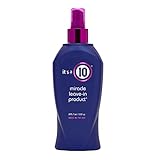
It's a 10 Haircare Miracle Leave-In Product, 10 fl oz
Best for: People who want one spray that detangles, conditions, and protects across every hair type
10-benefit formula that works as a detangler, conditioner, and styling primer in one step
- Marketed for every hair type from fine to coily; one fine-haired forum owner reaches for it as a heavier winter leave-in
- Spray format is harder to over-apply than a cream, though fine hair still wants it kept to the lengths
- Doubles as a detangler with enough slip to skip a separate product
- Strong fragrance that lingers; polarizing if you are scent-sensitive
- At around $32 for 10 oz it costs more per bottle than most drugstore leave-ins
(Affiliate link) · price may vary
It's a 10 · (Affiliate link)
3. Change what touches your hair. Plastic brushes are the usual culprit in the threads. Northeastern Global News, reporting Dimitrova’s tips, says metal combs disperse charge while plastic can worsen it. Boar bristle splits people: “Eliminates 90% of the static for me!” said one, while another wrote “all it did was make my hair greasier at the roots and staticky at the ends”. A 1985 study found no single comb material suited both untreated and conditioner-treated hair. If your hair is curly or coily, skip the boar brush: a dermatology guide to hairbrushes says boar bristle “may disrupt the natural curl pattern”. Picks: our hair brush roundup.
4. Watch the fabrics. Northeastern Global News, reporting Dimitrova’s tips, lists synthetic fibres as far more prone to static. “Wool is basically a static generator,” one r/Haircare commenter added. Swap the wool scarf or synthetic hat for one that does not set it off. At night a bonnet or smooth pillowcase cuts friction: “I started sleeping in a satin bonnet (under $20 on Amazon) and the amount of static has been reduced by like 75%.” Satin is a weave, not a fibre, and most budget satin is polyester, so check the label: “I prefer real silk because it doesn’t make my hair staticky which polyester satin does unfortunately.”
If your static is worst in the morning and you sleep on cotton, the Bedsure two-pack, under $10, is a low-cost way to test whether the pillow is the friction source; it has one of the largest review bases of any satin pillowcase on Amazon. It is polyester satin, and some forum posters say polyester satin made their hair more staticky, so if it gets worse, the polyester is the problem and real silk is the next step. None of the threads we read named it for static.

Bedsure Satin Pillowcase (2-Pack)
Best for: Bonnet refusers and restless sleepers; the whole pillow becomes the low-friction surface, so nothing has to stay on your head
Polyester satin with an envelope closure, sold as a two-pack, with one of the largest review bases of any satin pillowcase on Amazon
- Works every night with zero effort: no tie, no slippage, nothing to keep on your head
- Two-pack at a drugstore price, a low-cost way to test low-friction sleeping
- Envelope closure keeps the pillow from sliding out; machine washable
- Polyester satin, not silk; it sleeps warmer and less breathable than real mulberry silk
- Protects only the hair touching the pillow; curls still compress unless you also pile or wrap them
- The satin surface can feel slippery under the head until you are used to it
- Polyester satin can itself build static on some hair: a few owners in fine-hair and long-hair forums say satin made their hair staticky and that real silk did not
(Affiliate link) · price may vary
Bedsure · (Affiliate link)
5. Go easy with heat and the brush. Brush less once hair is dry: “Also avoid brushing/combing immediately after straightening.” Posters split on air-drying versus blow-drying; nothing we found settles it.
Ionic dryer makers say negative ions neutralise the charge. A chemistry lecturer writing for The Conversation finds the theory plausible but says the ion output is very small, so effects “would likely be subtle,” and that there is “no scientific proof” they dry hair faster by breaking up water droplets. One r/HaircareScience owner saw “Less static, frizz, smoother”; another owner noticed no difference, and a third commenter said flatly, “No, the ionic part makes no difference.” If you are replacing a dryer anyway, treat ionic as a tiebreaker; we would not buy one for static alone. Our hair dryer roundup covers dryers.
Fine hair: beating static without flat, greasy hair
About half the static threads we read describe fine hair, partly because we searched fine-hair forums. Use less, lower: ends only, a small amount to start, sprays over creams.
Lighter is the default. In the driest weeks one fine-haired poster traded a little volume for a heavier leave-in on the ends, the It’s a 10 switch above, and planned to go back when humidity returns. The AAD says fine, straight hair needs a lighter leave-in to avoid looking limp and greasy.
An r/finehair poster wrote: “I try using a little bit of conditioner on the body and roots but that still just ends up weighing hair down and making it look flatter and greasy and still staticky.” A second said that “as my hair is fine and straight, getting instantly greasy is always a concern.” A commenter in another r/finehair thread put it simply: “When you use conditioner, just use it on the ends only!”
If you blow-dry and want one spray that is also your heat protectant, OUAI’s leave-in is the light option: the brand rates its heat protection to 450°F and says it “tames flyaways”. It costs more per ounce than It’s a 10, and is too light for thick or coily hair that needs heavier moisture. None of the threads we read named it for static.

OUAI Multitasking Leave In Conditioner, North Bondi, 6 oz
Best for: Color-treated or heat-styled hair that needs thermal protection alongside conditioning
Combines leave-in conditioning with heat protection up to 450 degrees F in a single spray
- Brand-rated heat protection up to 450 degrees F, so it can stand in for a separate heat protectant spray
- Lightweight spray suited to fine-to-medium hair when used sparingly on the lengths
- Tamarind and amino acids smooth frizz and flyaways on color-treated hair
- The most expensive per-ounce spray in the lineup
- Too light for thick or coily hair that needs heavier moisture
(Affiliate link) · price may vary
OUAI · (Affiliate link)
For dry ends, Olaplex No.7 is our finishing pick. Treat it as a friction fix: “Bonding” is Olaplex’s word, and in practice it is a silicone-led oil used a few drops at a time. An r/Haircare commenter wrote “Ok it’s expensive but Olaplex bonding oil WORKS for friz/static,” adding, “Just don’t put more than a drop on each half of your hair or else it can look oily.” Silicones form a film that reduces friction, and cosmetic chemists at The Beauty Brains say conditioning ingredients with “quat” or “amine” in the name “conduct electricity better than silicones”, which is why the leave-in comes first. Not every poster agrees: some say oil or a silicone serum made their static worse. If that is you, try the drop on damp hair, or use a leave-in instead. It is pricey per ounce and some owners find it unremarkable; the light oils fine-haired owners name are on our hair oil page.

Olaplex No.7 Bonding Oil
Best for: The finishing oil fine-haired owners most often call the lightest they have found, for damp or dry hair
Olaplex calls it a bonding oil; in practice it is a silicone-led finishing oil used at 2-3 drops a use for shine, smoothing and frizz control
- Frequently named the lightest oil owners have found for fine or easily-weighed-down hair, next to heavier salon serums
- A little goes far: 2-3 drops per use means a small bottle lasts many owners a year or more
- Doubles as a pre-heat-styling smoother and a post-styling shine finisher on damp or dry hair
- Olaplex markets it as a heat protectant, but at least one owner who likes the oil says not to rely on it as your sole heat protectant
- Price per ounce is high for the bottle size, offset only by how little product each use takes
- Not everyone finds it does much: a couple of owners call it fine but unremarkable and stick with other oils
(Affiliate link) · price may vary
Olaplex · (Affiliate link)
Does static mean my hair is damaged or unhealthy?
Not on its own. Static is a surface charge, not a diagnosis. Dry or damaged hair, with more surface friction, can show it more, but healthy hair gets it in dry winter air too.
The forum splits on that. “The air being dry in the winter causes the static, not the health of your hair itself,” as one r/finehair commenter put it, against an r/longhair reply that “Static is a moisture issue so definitely leave in conditioner and/or a mask.”
Bleaching, colouring, heat and brushing speed loss of the hair’s protective lipid layer, raising friction, and more combing work means more charge. On dyeing, a dermatologist’s review says dyes and straighteners leave hair “susceptible to static electricity”, while the 1985 study found bleaching and dyeing had “only a small effect on triboelectric charging”. On long hair it can mean knots: “It’s constantly staticky, then knotting and matting,” wrote one r/longhair poster. See preventing breakage.
What we would skip
Four popular fixes are poor bets for static, or bets on the wrong problem.
- Hand lotion on oily roots. “Not for oily headed people though,” read the top r/lifehacks reply.
- Dry shampoo for static. No source we found studied it; posters split.
- A boar brush for fine, oily hair. Two r/finehair posters say it left the ends staticky.
- An ionic dryer bought for static alone. The evidence above is thin and the forum is split.