To prevent hair breakage, find where the short, blunt-ended pieces sit and change the habit that keeps stressing that spot. A ring at one height points to your tie, one side to a braid, strap or the side you sleep on, and snapped mid-lengths on lightened hair to bleach. Snapped and split ends can only be trimmed.
We read 354 Reddit threads from breakage searches, 184 of them about hair snapping or splitting, 11 opened individually, across nine subreddits led by r/HaircareScience, r/finehair and r/longhair; the archive search was patchy, so treat the counts as a sample. The hard part is not the habit list, which most people with breaking hair have already read. It is finding which habit is doing the damage, and the threads are full of people doing everything right and still snapping.
Is it breakage? A 30-second check
Look at the end of a short piece. A blunt, cut-off end means it snapped; a soft, tapered point usually means new growth. Short pieces at odd lengths near your hairline or part are often new hair, not damage.
That test comes from a low-scored r/femalehairadvice comment, so treat it as a rule of thumb: “If they have a blunt end, it’s breakage. If the end is softly pointed, it’s just new growth.” A reply with 241 points on an r/longhair thread made the same point: “Those are not split ends. Your hair is constantly growing and shedding and they’re different strand lengths.”
Doing all of it and still snapping? Look at what you have not changed: the scissors, a sleep mask, a coat collar, the clip you swapped the tie for. And some hair is simply more fragile. One r/finehair commenter put it plainly, in a low-scored reply: “at some point fine hair just breaks easier.”
If hair is coming out at the root rather than snapping along the strand, start with our guide for finer, sparser hair.
The five things that snap hair
Tension, rough detangling, friction, heat and chemical processing do the snapping, and wet hair is weaker than dry, so tugging and rubbing do more harm then. Damage adds up wash by wash until the weakest spot gives.
A 2011 lab study states it plainly: “Physical causes of hair shaft damage include friction from hair accessories, washing, and towel drying.” Kamath and Robbins, reviewing the combing studies, write that breakage in combing “results from tangling, looping, knotting, and impact loading.” In plain terms: a knot that gets yanked, a tie that saws at the same spot, a towel that rubs. None of the five needs a product to fix.
Where it’s breaking, and what that points to
Where the breaks sit is your best clue. Part your hair and check the back with a hand mirror, or compare the short pieces left in your brush, then read down the table.
| Where it breaks | What that usually points to | The habit that prevents it |
|---|---|---|
| A ring at the same height on the back of your head | A ponytail or bun in the same spot every day | Move the tie (high, low, side) and switch to a softer holder or a clip |
| One side more than the other | A braid always worn on one side, a bag strap, or the side you sleep on | Swap sides, keep straps off your hair, braid loosely for bed |
| Around the hairline and front pieces | Bleach overlap if you lighten; otherwise tight ties, then heat on the face-framing pieces | Bleach the hairline last or not at all, loosen ties at the front, less heat there |
| At the nape and collar | Rubbing against coats, collars, necklaces or a sleep mask | Wear it up or tucked away from rough fabric and jewellery |
| The ends only, split or frayed | Old, worn ends plus friction, or dull scissors | Trim with sharp hair scissors, keep ends off rough fabric and detangle them first |
| A patch where your clip or bun sits | The clip or bun in the same place daily | Move it, or swap in a hair stick or pin |
| Mid-length snaps on lightened hair | Bleach damage, often with heat on top | Space sessions, no overlap, no heat on fresh bleach |
An r/HaircareScience commenter (90 points) told one poster, “Your hair is breaking where your ponytail starts.” An r/longhair commenter (77 points) found breaks on “the side opposite of my braid”. On the hairline, an r/HaircareScience commenter (157 points) wrote: “Hairline hair is much more fragile and colours faster than the rest”.
Tie it up without breaking it
Change where you tie your hair and what you tie it with. A tight elastic in the same spot wears a line into the strands; looser styles, covered ties, clips and varied placement spread the wear. Let hair dry before you tie it up tight. No holder is breakage-proof.
Clips are not exempt: an r/Haircare commenter saw breakage where a claw clip sat, and an r/finehair poster who wore one most days was told it was the likely cause and to use a French pin instead.
The American Academy of Dermatology lists tight ponytails, buns and cornrows among habits that damage hair. Its fixes are “Wear hair loosely pulled back.” and “Use covered rubber bands made especially for styling hair.” An r/HaircareScience commenter (109 points) added rotation: “I vary both placement (high, low, to the side, etc.) and securing method (hair stick, fork, satin scrunchie, claw clip, etc.) to try to spread the tension and wear as best as possible”.
Bare elastics draw the harshest comments: “throw away all the hair ties. They do a lot of damage.” (r/longhair, 126 points). Fine hair complicates it. An 800-point r/finehair post, part joke, asks “Wdym your hair breaks to hell with so much as a silk scrunchie?” If that is you, clips and looser styles matter more than the tie.
If you still use a tie, make it a soft one. Kitsch’s satin scrunchies are our top pick for that: satin over a soft elastic, five to a pack, under $10. The hold is loose by design, so heavy hair may need a second loop, and it is satin, not silk. We found no threads on this scrunchie in our run (Kitsch came up only for other products, such as curlers and claw clips), so the pick rests on the tie type and a 4.6-star average across more than 54,000 Amazon ratings, very likely shared across colours.

Kitsch Satin Scrunchies (5-Pack)
Best for: Pineappling: a loose, high, satin-held ponytail is the classic way to protect curls overnight without covering them
Smooth satin over a soft elastic that holds a loose pineapple with less of the dent and pull a bare elastic leaves
- Gentle enough to sleep in: satin surface and soft elastic limit creasing and snapping
- Holds a loose high pineapple without pulling at the hairline
- Five-pack of an established brand at a drugstore price
- The hold is deliberately loose; very thick or heavy curls may need two loops or a bigger scrunchie
- Satin over elastic, not pure silk; a silk version costs several times more
- Hand wash only; the satin surface picks up gel and oil residue with nightly use
(Affiliate link) · price may vary
Kitsch · (Affiliate link)
Detangle and brush without snapping
Start at the ends and work up in small sections, and never pull a tool through a knot. Straight hair is usually safer detangled dry; curly and coily hair is safer detangled wet with conditioner for slip (more in the curly and coily section below).
The AAD says to “Slowly comb the ends of your hair first then keep combing higher to detangle your hair with minimal damage.” It tells people with straight hair to let it “dry a bit” before combing, while its curly hair page warns against “brushing your hair while it is dry” for thick, curly hair. One common rule of thumb on Reddit, from a low-scored r/Wavyhair comment: “Straight and wavy hair should be dry brushed before showering to decrease the chance of breakage.”
How often to brush splits the threads. An r/finehair post (252 points) is titled “Improved my hair by thoroughly brushing it 2x a day and not sleeping with it damp.” The AAD says “Hair never needs 100 brush strokes a day.” The rule that fits both: brush to clear tangles, not to hit a stroke count.
For wet hair, any smooth wide-tooth comb works, and a salon-brand one such as Paul Mitchell’s costs under $10. On dense coils a comb can stall, and forcing it is how hair snaps.
If you prefer a brush, flexible bristles give way around a knot. Wet Brush comes up in more than two dozen of the threads we collected; the Original costs under $10 and averages 4.7 stars across more than 78,000 ratings, very likely pooled across colours. An r/finehair poster called it gentle on fragile strands; another commenter (38 points) wrote that “the little beads at the end still ripped my hair.” Its “55% less breakage” line is the brand’s own claim. For brand choice, see our hair brush roundup.

Wet Brush Original Detangler Hair Brush
Best for: The universal everyday detangler: flexible IntelliFlex bristles bend through wet or dry knots on almost any hair type without the yank
Ultra-flexible IntelliFlex bristles that give way around a knot instead of ripping through it, wet or dry
- The default painless detangler for a reason: the bristles flex around knots instead of snapping through them, on wet or dry hair
- Works across straight, wavy, curly, thick and fine hair, which is why it is the safe pick if one brush has to cover a whole household
- Cheap enough (budget $ price) to keep one in the shower and one in a bag without a second thought
- It detangles but barely styles: the soft bristles will not smooth, add tension, or shape hair the way a paddle or boar brush does
- The fine ball-tipped bristles can splay or shed after months of heavy use, and some owners report the tips popping off
- Too soft to bite through very thick or tightly coiled hair in one pass; those textures still need sectioning
(Affiliate link) · price may vary
Wet Brush · (Affiliate link)
Drying: towel, air, dryer and blow-dry brushes
Blot or wrap wet hair; do not rub it. Wet hair is weaker, so cut the friction while it is wet. If your hair stays wet for hours, a dryer on low, kept moving about 15 cm (6 inches) or more away, is a fair trade; blow-dry brushes recur in the breakage threads we found.
The AAD says to “Wrap your hair with a towel or t-shirt to gently absorb the moisture, as roughly rubbing your hair dry can cause damage.” The 2011 dryer study notes that “Friction is a major damage factor of the hair surface, especially in wet hair”. Our plopping guide covers the towel technique.
Air-drying versus a dryer divides the threads. “As long as the hairdryer isn’t extremely hot, it can be less damaging than air-drying”, argued one r/HaircareScience comment (162 points); others say heat damages hair in itself. The same 2011 study found a dryer at 15 cm, kept moving, did more surface damage than natural drying but spared an inner layer that slow air-drying damaged, in lab tresses: one lab, so a reason not to fear a gentle dryer, not proof that air-drying harms hair.
Breakage is a recurring complaint in the Revlon One-Step threads: of 10 recent ones we found through a web search, 9 report breakage or damage. “You’re basically placing a blow dryer directly on the hair instead of 6 inches away”, one r/longhair commenter explained. These are reports, not a verdict, but if your breakage started with one, stop using it first.
Heat styling: lower, slower, less often
Use the lowest setting that styles your hair, one slow pass rather than several, fully dry hair only, and heat-free days. Irons are harsher than dryers, and damage adds up.
The AAD’s rule is to “Use low or medium heat settings and a product to protect your hair from the heat”, and its habits page puts blow dryers, hot combs and curling irons at about once a week or less, and says to air-dry when possible. A 1984 study found a critical temperature of 140 degrees C (284 °F), above which changes to the hair’s structure were “profound and irreversible”, and a 2011 study noted flat irons operate at temperatures over 200 °C. Those are lab figures; no source we found gives a safe home dial setting, so start low and go up only as far as the style needs.
“Heat damage is cumulative,” wrote one r/HaircareScience commenter (108 points), and an r/longhair commenter added, “Flat irons are harder on hair than blow dryers”. A stylist told a poster whose salon used a 450°F iron that “the high heat is so we can style your hair quicker than you would be able to at home,” which is the case for a lower dial at home.
CHI 44 Iron Guard is the overall pick on our heat protectant page and an inexpensive one (under $15), with a 4.5-star average across more than 72,000 Amazon ratings. The 450°F rating is CHI’s figure, not a safe target. It contains denatured alcohol, so spray it right before heat, and some buyers find it stiff. It also contains keratin, so if protein seems to make your hair brittle (see below), pick a protein-free spray from our roundup. The CHI mentions we found give no breakage verdict on this exact product. Our heat protectant roundup compares the options.
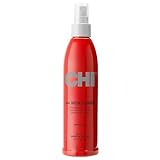
CHI 44 Iron Guard Thermal Protection Spray
Best for: Most people who heat-style regularly and want one inexpensive spray that holds up across fine, wavy, and curly hair before a blow-dry, curl, or flat iron
A thermal spray with hydrolyzed silk and keratin that CHI rates to 450F, which owners with fine and thick hair describe as light on the hair
- Named in blow-dry and silk-press routines by fine-haired and curly Reddit users in our heat-protectant research
- Rated by CHI to 450F, the ceiling most flat irons and curling wands reach; the rating is the brand's, and no protectant prevents heat damage entirely
- One of the most budget-friendly thermal sprays on Amazon, with a review base over 70,000 ratings
- Contains denatured alcohol; follow the label and let hair dry fully before an iron touches it, rather than treating it as an all-day leave-in
- Some buyers find it can feel stiff or sticky and say it is harder to rinse out than lighter sprays
- The scent is noticeable on application, though reviewers say it fades quickly
(Affiliate link) · price may vary
CHI · (Affiliate link)
Bleach and colour: the breakage you cannot undo
Space out lightening, never overlap bleach onto lightened lengths, do the hairline last, skip heat on fresh bleach, and strand-test first. If wet hair stretches like gum and snaps, cut it.
One study found bleached fibres showed “substantial damage to the cuticle layers and to the cortex”, and another measured a drop in breaking strength in bleached hair. A 2019 study across hair textures called bleaching and dyeing “very aggressive to hair structure.” The AAD advises one chemical service at a time, with perming or relaxing first and colouring two weeks later.
“I think your hair is so damaged from the bleach, so it breaks as fast as it grows = no growth”, read one r/longhair comment with 629 points. On fresh bleach, a top r/FancyFollicles reply (639 points) was direct: “You can’t apply heat to bleached hair the same way you could to colored or natural hair”.
Bond builders help some people, but they cannot rejoin a snapped strand. As an r/HaircareScience comment (100 points) put it, “Olaplex also can’t mend hair that has already been broken or frayed, nothing can do that.” For how the main bond builders differ, see Olaplex vs K18; for what to do with hair that is already damaged, in order, see our repair guide.
At night: loose, tied and smooth
Sleep with your hair in a loose braid or loose bun, with no tight elastic. The loose braid matters most; add a satin or silk pillowcase or bonnet if your ends still catch on the pillow. No study we found measures how much it helps.
The AAD’s curly hair advice is a loose pineapple or braid to “reduce friction against your pillowcase, which can make your hair frizzy and easier to break.” A Cleveland Clinic article quoting dermatologist Shilpi Khetarpal says swapping a cotton pillowcase for satin or silk “can help,” with the condition that you let your hair dry before bed.
Posters split on the trade-offs. “My satin pillow case is 95% of the reason my hair stopped breaking,” wrote one r/longhair commenter (39 points). Another in the same thread had a practical gripe: “my pillows always fall off my bed since they’re so slippery.” Silk costs more, and satin can feel slippery or staticky. Our guide to sleeping with curly hair covers night styles in detail.
What a trim can and can’t fix
A trim removes split and broken ends; nothing glues them back together. Cut above the damage with proper hair scissors, and trim when splits show rather than on a calendar; posters range from every six weeks to once a year. If splits are back within a month of a cut, check the scissors first.
A 2007 industry paper states that “there are no conventional systems that will permanently mend split ends”; the paper’s own temporary mend rinses out with shampoo. The highest-scored comment in our deep reads (449 points) was about the tool: “If you dont use proper sharp hairdressers scissors you’ll get split ends like this a month or so after you trim it.” An r/HaircareScience commenter (16 points) was blunter: “Nothing repairs split ends. You need to cut.”
Some posters and Healthline say that splits can travel up the strand, and the 2015 hair-cosmetics review describes splits running along the fibre, but we found no study showing that trimming early saves length. Snipping single split ends by hand divides the threads; dusting (a very light trim of just the tips) is a middle path while you grow your hair.
Protein, bond builders and “overload”
If your hair got more brittle after you added a strengthening product, stop it for a few weeks and see. The idea of “protein overload” has no study behind it.
The top reply (272 points) to an r/HaircareScience poster with frizzy, broom-like hair: “If you’re using products, shampoos and conditioners with protein and Keratin, I would stop that and switch to only moisturizing products.” Another commenter (66 points) added, “protein will make my hair snap off real quick.” A 2026 r/finehair post (369 points) thanked “the person that mentioned their hair was very sensitive to protein in hair products” after dropping it eased their dry ends.
The evidence is thin. r/HaircareScience’s moderator bot answers the question with “Currently there is no scientific evidence that supports the concept of protein overload”, and Healthline calls it “mostly anecdotal as of now.” Our shampoo guide for damaged hair covers product choice.
Curly and coily hair: knots, sections and less handling
Detangle in sections with conditioner, handle your hair less between wash days, and use protective styles to keep length. Single-strand knots come up again and again in curly and coily threads.
The AAD’s curly hair advice is to “Work in sections to make detangling easier.” An r/Naturalhair commenter (43 points) described the routine: “I part my hair into four sections and then wet it and add some leave in conditioner and gently comb the sections out.” Another (56 points): “Growing out hair means leaving it alone and not over complicating the process.”
Knots are the recurring complaint. One commenter (14 points) linked them directly: “i get a lot of single strand knots when my hair is out- which causes breakage. If you want to retain length, then use protective styles.” Matted hair comes out slowly from the ends, a small section at a time, or with a stylist who knows your texture.