Pull the hair out while the brush is dry, swish or soak it in warm water with dish soap or shampoo, scrub between the rows with a toothbrush, rinse, and let it air dry bristles down unless the maker says otherwise. Keep wooden backs and cushion pads dry. The grey fuzz is most likely shed hair and fabric lint held on by oil, skin cells and product; we found no study that has measured it.
We read 294 Reddit threads from brush-cleaning searches, 62 of them about cleaning a brush, 12 opened in full, mostly r/CleaningTips with r/Hair, r/HaircareScience, r/Haircare and r/hairstylist; the archive search was patchy, so treat the counts as a sample. The highest-scoring of the brush-cleaning threads in our sample, an r/CleaningTips post with 1,782 upvotes, opens with an owner bracing for the job: “Just thought I check with you all before I go at this with a needle and tweezers.”
Below: what the fuzz is made of, the five-step method, a table of which brushes can soak, the dish soap question, what salons are required to do, and when a brush is worn out.
What the grey fuzz is, and why it keeps coming back
A mix of shed hair, oil, skin cells, dust, product and fibre lint. No study we found has analysed what collects inside a used hairbrush, so this is the sum of its parts, sourced where a source exists.
Hair carries a thin film of liquid phase sebaceous lipids. Skin sheds cells in a process that is orderly and essentially invisible. Airborne particles stick to hair, and one study of hair in severe city pollution (Baoding, China, not a bathroom) found this phenomenon is increased by the presence of sebum. Hairspray leaves a thin film on the surface of hair. A starch-based dry shampoo can add powder: Lab Muffin’s Michelle Wong found one product’s main ingredient was starch, so dry shampoo residue may add to it (one product, weak evidence).
The lint part is forum framing: several posters blame towels, and one adds blankets and sweaters, and one wrote, “When I stopped using towels on my hair & switched to using a tshirt, it cut the lint SO SO much.”
Why it keeps coming back is simple: every brushing adds more shed hair, lint and product, and the oil holds it at the base of the bristles; as Lab Muffin puts it, sebum tends to stick to other things like dirt, dust, skin flakes and pollution. Our inference from that: a quick hair-out every few uses does more than an occasional deep clean. It is hardest to clear from ball-tipped pins, where fuzz wraps under the balls. “I could never clean the kind with little balls on the pins!” wrote one poster who switched brushes.
How to clean a hairbrush, step by step
Five steps. Free tools first: fingers, a rat-tail comb, tweezers, a metal eyelash comb (the top-scored answer in our sample: “Metal eyelash comb.”), an old toothbrush, a mascara spoolie, a seam ripper for fuzz wound tight at the base, and dish soap.
1. Get the hair out while it is dry
Run a comb along the base of each row, then tweeze the rest. One r/HaircareScience commenter: “Scrape through the bristles with a rat tail comb, then bang vigorously off a counter top.” Go gently around ball tips: “I used to use a comb, but it pops the bristle tips off.” If it will not lift dry, wash first and come back with the comb; one of the higher-scored method lines soaks first: “After a good soak I pull out all of the hair then scrub with a nylon brush”.
If you clean often, Denman’s DBC1 cleaning brush is our pick for the job, and one of the tools posters named by brand: an r/longhair commenter wrote, “It’s called “the denman brush cleaning brush””, and an r/CleaningTips commenter recommends a “hairbrush cleaning brush” as the step before washing. It is a budget buy (under $15), 4.6 stars across more than 6,500 ratings of its own. The catch: a toothbrush and comb do most of this free, and fuzz wound tight at the base can still need tweezers, a seam ripper or a long scrub: one r/CleaningTips poster reported that “Glue, fingers, tweezers, metal brush cleaner, and baking soda in warm water didn’t help”, and scrubbing under running water did.

Denman DBC1 Hairbrush Cleaning Brush
Best for: The purpose-made cleaning tool: a stiff-bristled brush for raking shed hair and grey fuzz out of any hairbrush before it goes near water
Stiff nylon bristles on a handled head, with a bristle tip at the end for lifting hair, dust and fluff from between the rows
- Named in two brush-cleaning threads: one commenter says they got theirs on Amazon, another links this exact listing as the step before a wash
- No colour or size variants on the listing, so its 4.6-star average across more than 6,500 ratings is its own, not a shared family pool
- Denman prints a care line for it: wash in warm, soapy water, rinse, and leave to dry away from direct heat and sunlight
- Worked hard between ball-tipped pins, any cleaning tool can pop the tips off; go gently on a Wet Brush or a cheap cushion brush
- Fuzz wound tight at the base of the bristles still needs tweezers or a seam ripper; one poster found a metal brush cleaner did not help and a scrub under running water did
- An old toothbrush and a rat-tail comb do most of the same job for free; this earns its price on convenience, not on anything a free tool cannot do
(Affiliate link) · price may vary
Denman · (Affiliate link)
2. Make the wash
Warm water and a squirt of dish soap or shampoo. Surfactants let oil be smuggled into the water in tiny droplets, and Lab Muffin notes the same anionic type sits in both shampoo and dishwashing detergent; a 1979 study found anionic surfactants significantly more efficient at lifting hair oil than a non-ionic one. A clarifying shampoo works too if you own one; you do not need one.
3. Soak or swish, by brush type
All-plastic brushes with no pad or wood are the ones posters soak, a few minutes at most; Tangle Teezer’s own page uses a bowl of warm soapy water and a toothbrush. Everything else gets dipped bristles-first, with the back and pad held clear; the table below decides. One commenter works in short bursts: “I do small increments of time so i can ensure no finishes on the brush get ruined.”
4. Scrub between the rows
A toothbrush, nail brush, spoolie or two soapy brushes rubbed together. “A toothbrush works good to scrub between the rows of bristles with a cleanser.”
5. Rinse, blot and dry bristles down
Rinse the bristles under the tap with the back and pad still clear, blot, and lay it face down. “Rinse and then i let everything air dry with the bristles side down on a towel,” wrote an r/CleaningTips commenter. A cushion pad must dry right through, which is slow. The EPA’s rule for water-damaged areas and items is to dry them within 24 to 48 hours to prevent mold (a building rule, not a brush study).
Which brushes can soak, and which cannot
Only all-plastic brushes with no pad or wood should sit in water; the rest get a bristles-only dip and a long dry.
| Brush type | Soak or swish | Wash with | How to dry | Watch out for |
|---|---|---|---|---|
| All-plastic detangler or vented (Tangle Teezer, Wet Brush) | Dip, or a short soak; Tangle Teezer uses a bowl of warm soapy water and a toothbrush | Dish soap or shampoo | Air dry, teeth up (Tangle Teezer) | Lint on ball tips; do not open it (Tangle Teezer) |
| Cushion or paddle brush | Dip bristles only, pad dry (Healthline); cover any air hole (Denman) | Dish soap or shampoo | Face down until the pad is dry | Water in the pad |
| Boar bristle (wooden handle or cushion pad) | Swish; do not submerge (Kent) | Shampoo or mild detergent (Kent) | Bristles down, no heat or sun (Kent) | Wet wood; hot water |
| Wooden pin or bamboo | The pins are the wood: wipe, do not soak; follow the maker | Damp cloth with a little shampoo | Bristles down, no hot air | Swelling and cracking (Wood Handbook, Spornette) |
| Round brush | Plastic barrel: swish; wood or boar: as the boar row; metal or ceramic: the maker’s page decides | As the row it matches | As the maker says | The maker’s page decides |
| Denman D3 (removable pad and pins) | Slide the pad and pins out (Denman); wash the pins and handle | Warm soapy water (Denman) | Air dry before reassembly | Follow Denman’s guide for the pad |
| Combs | Plastic: soak; wood: wipe | Dish soap or shampoo | Flat | Wood follows the wood rules |
The wood rule has the firmest backing. The US Forest Service’s Wood Handbook says contact with liquid water can induce rapid changes in wood’s moisture, and swelling and shrinking can warp and split it. Kent says to make sure the water does not reach the wood, and Spornette says soaking will cause the wood to crack and the coating to peel off.
Boar bristle is keratin, the main component of human hair, which is the background to Kent’s instructions for its bristle brushes: lukewarm suds, bristles only, no heat. Posters split: “Don’t soak it for one,” wrote an r/beauty commenter, while an r/Haircare commenter scrubs two soapy brushes together in the shower: “I do this with my boar bristle-y brush and my wet brush all the time and it works great”.
Pads are a drying problem. The EPA says of mold that none of them will grow without water or moisture; we found no study of brush cushions, but it is a good reason to follow Denman’s advice to cover the hole when submerged in water and Healthline’s to keep the padding dry.
You do not need a new brush to clean the one you own; the three brushes with cards below are here as the examples of each material, and because if the wear checks further down say replace, they show what each design asks of you at cleaning time. Tangle Teezer is the easy case: its care page says warm soapy water, then air dry naturally with the teeth facing upwards, no hairdryer, and do not try to open it. “They’re super easy to clean,” wrote an r/longhair commenter. Budget, with a very large review base; the downsides are no handle, a slippery wet grip and slow going on long thick hair. Wet Brush owners wash theirs freely too (no pad), though it is the forum’s fuzz magnet; our hair brush roundup has the full brush picks.

Tangle Teezer Ultimate Detangler Brush
Best for: The dry-smoothing detangler: two-tier teeth that pull out knots and lay the cuticle flat for less frizz in one pass
Patented two-tier teeth (long teeth detangle, short teeth smooth) for frizz control on wet or dry hair
- The two-length teeth do two jobs at once: the long teeth loosen knots while the short teeth smooth the surface, so dry hair looks less frizzy in a pass
- The palm-held shape gives more control and downforce than a handled brush for a quick smooth-out
- Works on wet or dry hair and doubles as a product-distribution brush in the shower
- No handle: the palm-held shape is polarizing, and wet or soapy hands lose their grip on it
- The compact head is slow going on very long or very thick hair next to a wide paddle
- Priced above the plain detanglers for what is still, mechanically, a detangling brush
(Affiliate link) · price may vary
Tangle Teezer · (Affiliate link)
A budget cushion paddle such as Conair’s ultra-wide is the usual case here. Wash the bristles only, cover any air hole with a thumb, and dry it face down. No Reddit thread in our sample named it; of cushion brushes generally, one r/CleaningTips commenter found “water gets under the squishy part and it takes forever to dry.” Ball tips plus a pad make it the kind posters find hardest to dry well, so give it the most patience.
For boar on wood, Belula’s mid-range brush (a wooden handle, per its Amazon product details; we treat it as the wooden-back case) carries 4.4 stars across more than 13,000 ratings. No Reddit thread in our sample named it. One owner finds a boar brush gets dirty fast: “it only takes like one brush to get dirty again,” wrote an r/Haircare poster, and a reply called theirs a “pain in the ass to clean”. Clean it often, keep the wood out of the water, and expect some shedding.
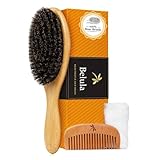
Belula 100% Boar Bristle Hair Brush
Best for: The shine-and-oil brush for fine or thin hair: soft boar bristles that carry the scalp's own oils down the strand
100% boar bristles that distribute the scalp's natural oils to add shine and cut static on fine to medium hair
- Soft boar bristles move the scalp's own oil down the hair, which adds shine and cuts static without a product
- Gentle enough for fine, thin hair and sensitive scalps, where stiff nylon pins feel harsh
- Arrives as a set with a comb, headband and travel bag at a mid ($$) price
- Not a detangler, and the maker says so outright: the short, soft bristles cannot work through a knot
- Those same short bristles only reach the surface of thick or long hair, so you have to brush in small sections
- Boar brushes shed a few bristles over time, and some owners find the set's extras flimsy
(Affiliate link) · price may vary
Belula · (Affiliate link)
The Denman D3 comes apart: its rows of pins pull out, and Denman’s guide says to remove the pad and pins from the handle by sliding up for a deep clean. “That brush disassembles,” one commenter replied to a grimy one. Mid-range, with a very large review base and a pad sold as anti-static (our static hair guide covers the static side); it is a styling brush first, owners report flat roots, and it is no gentle detangler, which our curly brush picks cover.
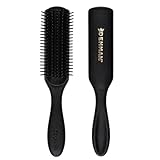
Denman D3 7-Row Styling Brush
Best for: The curl-definer: seven rows of round-ended pins that clump and shape curls and coils, usually over leave-in in the shower
Seven rows of round-ended nylon pins in an anti-static rubber pad for defining curls and smoothing
- The curly community's reference brush for turning separated strands into defined, clumped curls, usually worked through leave-in in the shower
- Rows of pins pull out, so the brush can be softened for looser or more fragile curl patterns
- Round-ended pins and an anti-static pad glide without the static a plastic paddle throws
- It defines by adding tension, which costs volume: flat roots and, on coily hair, more shrinkage are the recurring owner complaints
- It smooths and clumps but is not a gentle wet-detangler for knots; the knots come out first, with something else
- Aggressive with every row in: on some curl types it thins the clumps or adds frizz, which is why owners remove rows
(Affiliate link) · price may vary
Denman · (Affiliate link)
Dish soap, shampoo, vinegar or baking soda?
Dish soap and shampoo both work, through the same kind of surfactant; use whichever you already own.
Posters use Dawn on plastic and nylon brushes, and the surfactant logic says why; on a boar or wooden brush follow the maker, and Kent says shampoo or a mild detergent. “Cheap nail brush and dish soap or a clarifying shampoo,” as one r/CleaningTips commenter put it.
Vinegar and baking soda are often a family habit: one r/CleaningTips commenter’s mother, born in 1916, “always soaked our hairbrushes in warm water with baking soda.” No source we found tests either on a brush; Healthline suggests baking soda for extra cleaning power without saying why. The Beauty Brains, writing about hair, say vinegar’s one job is helping to remove mineral buildup and that baking soda is not a good oil absorber. No health, chemistry or regulatory source we found calls vinegar a disinfectant.
Some posters say a parent soaked brushes in ammonia or bleach. We do not recommend either, and never mix cleaning agents.
Can a dirty brush make clean hair greasy?
Healthline says that with an unclean brush all that dirt, oil, and gunk can get back into your hair, which is the mechanism Healthline gives for a dirty brush making clean hair look greasier sooner; we found no study that measured it.
Fine hair can show it, one r/finehair commenter found: “I just realised that my super fine hair gets weighed down from oil on my brushes.” It is not the whole answer: an r/femalehairadvice poster listed “Cleaning my brushes daily” among things that failed. Our greasy hair guide has more.
What hairdressers do, and whether you need to
Salons wash, then disinfect, because state rules such as California’s and Texas’s require it. This guide covers the washing; the disinfectant step below is salon practice and label directions, and nothing we read says a household brush needs it.
California’s board says to first remove all visible debris from hair brushes, wash them with soap or detergent and water and rinse; its rule then requires full immersion in an EPA-registered disinfectant before every client, for tools that can be disinfected. Texas’s rules require tools cleaned and disinfected before each client, and brushes cleaned by manually scrubbing with soap and water at day’s end, with immersion for tools “which may be safely immersed”, for the label’s contact time, and the EPA says the surface must stay visibly wet for that whole time. Washing comes first because the CDC says soil left on an instrument makes disinfection less effective or ineffective.
Barbicide says to submerge non-porous tools for 10 minutes, with the solution replaced daily, then rinse the tools and store them dry. Nothing in the rules or on the label says a boar, wooden or cushion brush belongs in the jar, so keep those out. The forum version, from r/Hair: “scrub it with soap and hot water, and then immerse it in Barbicide”. Practice varies; a commenter on r/hairstylist who says they have been in the industry 20 years wrote, “I can honestly say that most stylists clean a lot less than you’d expect, especially when it comes to shears and clippers.”
How often to clean it, and when to replace it
Pull the hair out every few uses; Healthline’s rule is a wash weekly with styling products, every few weeks without. Replace on wear, not on a calendar.
Healthline suggests once a week with regular gels or hairspray, every 2 to 3 weeks otherwise; Olivia Garden, a brush maker, says at least once a month, ideally twice. Posters range from after every use to “I just pull the hair out.”
Spornette says to replace a brush when the beads on the bristles break off or melt; we would also replace on bent pins, bristles that snag, or a cushion that will not dry. Most of the high-scoring answers say clean first (one 184-upvote reply did say it was time for a new brush): “You don’t have to replace it, just clean it.” If yours fails those checks, our brush roundup covers which brush to buy next.
What we would skip
Five things we would skip: heat, the dishwasher for wood or pads, ammonia and bleach, alcohol sprays, and binning a brush that only needs a wash.
Heat. “Whatever you do, DON’T try to singe them,” as one r/CleaningTips commenter put it; another’s fiancé “had the bright idea to use a lighter and technically got rid of the hair problem but also the entire brush.”
The dishwasher. Some posters run their plastic brushes through it; the makers’ care pages we read do not mention it, so check yours, and never with wood or a pad: “if it has a wooden handle then definitely that’s a NO.”
A new brush when the old one only needs a wash. Most of the high-scoring replies to people who asked say clean it, not replace it.
Ammonia and bleach, for the reasons above, and vinegar as a disinfectant. Alcohol sprays too: the CDC notes alcohol’s activity drops sharply below 50% concentration and that it can harden rubber with repeated use, which is our reason to keep it off a cushion brush.