Greasy hair comes with a strange amount of shame. One of the most-answered oily-hair posts on r/finehair opens with someone so embarrassed they used a throwaway account to ask why their hair turns greasy a day after washing. I spent an afternoon in the greasy-hair threads on r/finehair and r/HaircareScience, and the thing people are stuck on is rarely the products. It is guilt: the belief that washing daily is “wrong,” that their scalp should have learned to produce less oil by now, and that everyone else knows something they don’t.
Here is the version nobody profits from telling you. How much oil your scalp makes is set mostly by your biology, you cannot wash your way into changing that rate, and managing it well comes down to technique, product weight, and a periodic reset. This guide covers the mechanism, the “hair training” myth, and the fixes that hold up.
The short answer
Your scalp’s oil output is driven by genetics and hormones, and there is no good evidence that any shampoo schedule changes how much it makes. Fine and straight hair just shows oil fastest. Wash as often as your hair gets oily (daily is fine), shampoo the scalp rather than the lengths, keep heavy products off your roots, and use a clarifying shampoo when buildup creeps in.
| Your symptom | The likely lever |
|---|---|
| Greasy by the end of day one | Normal for fine or straight hair; wash daily, adjust technique |
| Greasy immediately after washing | Buildup, a too-heavy shampoo or conditioner, or hard water; clarify and lighten |
| Greasy roots, dry ends | Shampoo the scalp only; condition from the mid-lengths down |
| Greasy plus flaking or itching | Oil plus a flaky scalp is a dandruff question, not a grease question |
| Suddenly greasier than it used to be | Hormones and medication move the baseline; a professional beats a new shampoo |
Why hair gets greasy in the first place
Sebum, the oil your scalp produces, is made by sebaceous glands that sit at the root of each hair. A review in Dermato-Endocrinology notes those glands are largest and most concentrated in the face and scalp, and that their activity is driven by androgens, the hormone group your body regulates on its own schedule. A twin study in the British Journal of Dermatology covers the genetic half: identical twins had virtually identical rates of sebum output while non-identical twins differed, which the authors say suggests sebum output is under genetic control. That is why oil output varies so much from person to person, and why it can shift with life stages. People in the threads we read described the same pattern from the outside: less oil during pregnancy, more after coming off certain medications, with the baseline snapping back either way.
The other half of the story is visibility. Reddit’s fine-hair community converges on an observation that matches everyday experience: on straight, fine hair, oil travels down the strand easily and there is less hair per strand to absorb it, so the same amount of sebum that would disappear into thick curls reads as an oil slick by the afternoon. Greasy-looking hair is often ordinary oil production on a hair type that displays it.
Neither of those is a hygiene failure. This matters because the most upvoted responses in these threads are not product recommendations. They are permission: it’s okay to wash your hair every day.
Can you train your hair to be less greasy?
No good evidence says you can. Spacing out washes has not been shown to slow your scalp’s oil output, and the American Academy of Dermatology’s guidance points the opposite way: wash your hair based on how often it gets dirty or oily, and if you have straight hair and an oily scalp, you may want to shampoo every day.
The “train your scalp” idea is everywhere, so the record deserves a look. In one r/HaircareScience thread built around exactly this question, the stories stack up the same way: a commenter who stretched washes to every three or four days for fifteen years and still goes greasy by day two, and another who spent a full year on the whole program (sulfate-free, co-washing, vinegar rinses, dry shampoo, gradual spacing) before concluding they simply have oily skin, scalp included. The same stories repeat across the thread and its siblings: for people with oily scalps, training fails far more often than it works.
Two honest caveats keep this from being a strawman. A minority in those same threads say gradual spacing did work for them, and that experience is real; what most likely changed is their tolerance and their styling, which is a perfectly good outcome. And there is a measured reason training can appear to work: scalp oil does not keep piling up. A study of 1,325 people from seven ethnic groups found oil on the scalp climbs after a wash and levels off two to three days later. Hair that stops looking progressively greasier after a few days has reached that plateau; it is not evidence your glands have slowed down. If you prefer washing less and can live with the in-between days, nothing is wrong with that. Just don’t suffer through it expecting your glands to get the memo.
How to get rid of greasy hair: what actually works
The levers below are ordered by how much they move for the people who described trying them. None of them changes how much oil you make. All of them change how much of it ends up visible.
Fix your washing technique first
Most “my shampoo stopped working” stories are technique stories. Apply shampoo to your scalp rather than down the lengths, which is also the AAD’s advice, and work it in with fingertips. When hair is very oily, shampoo twice: the first pass binds to oil and buildup and barely lathers, the second does the cleaning. The most detailed routine we found (130 upvotes on r/finehair) adds two rules worth stealing: conditioner only from the jaw down, and washing your hairbrush at least weekly. Rinse longer than feels necessary, too. Leftover shampoo and conditioner read as grease within hours.
Audit the weight of everything you use
Oil-prone hair does badly with rich, heavily moisturizing formulas. As one r/Haircare commenter put it, a heavy conditioner won’t make your scalp produce less oil, but it will coat the strand, so each day’s new oil builds on that coating and the whole thing looks greasier sooner. Choose lightweight shampoos and conditioners, keep masks and oils on your mid-lengths and ends, and treat “hydrating” claims with suspicion at the roots. On the sulfate question the community splits: plenty of oily-scalp users report sulfate-free formulas never quite cut the grease, while others do fine with a second lather. Neither camp is wrong; stronger cleansers clear oil faster, gentler ones trade thoroughness for mildness.
Our oily-hair shampoo picks are selected for exactly this lightweight-but-effective brief.
Reset with a clarifying shampoo when buildup creeps in
Product residue, silicones, and mineral film accumulate slowly until one day your hair feels greasy an hour after washing. A clarifying shampoo once every week or two clears the slate, and one with chelating agents also takes on the mineral side. In the threads we pulled, this was one of the most repeated turnarounds: one poster wrote that a clarifying shampoo “just changed my life,” and a clarifying reset is among the first fixes offered to people who are “greasy even after washing.” The counterweight is just as consistent: clarify too often and hair turns to straw. A stylist in one thread warns to cut back and alternate the moment hair or scalp starts feeling stripped.
OUAI Detox is the reset the community keeps landing on, a premium ($$$) apple-cider-vinegar formula with chelating agents that also pull hard-water minerals. One caveat if your hair is color-treated: stronger clarifiers can speed up color fade, which is part of why this sulfate-free, color-safe formula is the version we card here. Treat it as a once-every-week-or-two product at most; used more often, posters report exactly the straw effect above. And buy it from a first-party listing. One r/Haircare thread documents convincing counterfeits from third-party resellers.
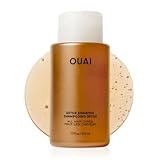
OUAI Detox Shampoo
Best for: Color-treated hair that needs periodic clarifying without accelerating fade
Apple cider vinegar plus chelating agents remove product and mineral buildup while preserving color
- Apple cider vinegar exfoliates buildup while chelating agents remove hard-water minerals and chlorine
- Sulfate-free and color-safe; designed to clarify without pulling dye
- Keratin in the formula helps smooth and strengthen hair after the clarifying strip
- At $34 for 10 ounces, it is a premium-tier price for a shampoo used once every week or two
- The ACV scent is noticeable during use, though it rinses out
- For heavy product buildup (thick silicone layers), it may need a double wash to fully cut through
(Affiliate link) · price may vary
OUAI · (Affiliate link)
If the price stings, the drugstore end of the category does the same job with less polish. Suave’s Daily Clarifying ($) has a devoted r/finehair following; one commenter calls it “the fine hair holy grail” for buildup and oily hair, though one thread grumbles about a formula change and the same overuse caveat applies. The full field, budget to premium, is in our clarifying shampoo roundup.
Use dry shampoo as a bridge, not a wash
Dry shampoo buys you a day, and it works better applied early. The trick the fine-hair community swears by is preventative application: a light pass on clean, dry roots before the oil arrives, rather than a heavy rescue coat on day two. Its limits are worth knowing. Dermatologists interviewed by the AAD are blunt that dry shampoo absorbs oil but does not clean hair, and recommend a real wash after one or two uses, since accumulation can contribute to breakage, and skipping real washes can leave the scalp itchy and irritated.
Batiste Original ($) is the drugstore workhorse here: rice-starch, fast, cheap, everywhere. It also leaves a white cast on darker hair, and its most common complaint in the threads we read is scalp itch a few hours after a heavy application. Some people who quit daily dry shampoo list it among the changes that calmed their scalp down.

Batiste Original Dry Shampoo (Classic Clean)
Best for: The reliable, inexpensive everyday workhorse for light-to-medium hair
Rice-starch formula that soaks up root oil fast at a drugstore price
- One of the cheapest credible options and stocked almost everywhere
- Rice-starch formula with no sulfates, parabens or ammonia absorbs oil quickly
- Adds noticeable body and texture, not just oil control
- Leaves a white cast on darker hair unless you apply it at night and let it settle (use the Dark version instead)
- Several long-time users report it can make the scalp itch after a few hours, and the heavy scent isn't for everyone
(Affiliate link) · price may vary
Batiste · (Affiliate link)
Powder formats, tinted versions, and the newer rinse-free sprays are compared in our dry shampoo roundup.
Sweep the habits nobody suspects
A short checklist from the threads, each one cheap to test. Wash your hairbrush and combs; a brush full of old oil re-greases clean hair on the first pass. Change or wash pillowcases more often. Don’t sleep on damp hair. Keep your hands out of your hair during the day. And keep conditioner, serums, and oils off your scalp entirely.
Rule out hard water
If your hair feels waxy rather than oily, never quite rinses clean, and shampoos seem to stop working over time, hard-water mineral film may be compounding the grease. A chelating or clarifying shampoo can help remove that film; formulas with chelating agents are the ones aimed at minerals specifically. We cover the fix in detail in our hard-water shampoo guide.
Still greasy right after washing?
Work through four causes in order: technique, product weight, buildup, water. First, confirm you’re shampooing the scalp itself, twice if needed, and rinsing thoroughly. Second, check whether your daily shampoo or conditioner is too rich for your hair; “greasy out of the shower” is the classic sign. Third, run a clarifying wash; if one reset fixes it, buildup was your answer. Fourth, if the reset doesn’t hold, look at hard water. One of these four explains nearly every “I washed it an hour ago and it’s already greasy” post we read.
When it’s more than grease
Grease plus flaking, itching, or an angry scalp is a different problem. Oily skin is one of the reasons dandruff can develop, according to the AAD’s dandruff guidance.
A dermatologist interviewed by the AAD warns that relying only on dry shampoo and skipping washes with shampoo and water could lead to seborrheic dermatitis, which can cause an itchy, scaly rash on the scalp. If your scalp is flaking or itching, start with our dandruff shampoo guide rather than an oil-control routine. If you see a rash, or the itch has not settled after a few weeks, see a board-certified dermatologist; the AAD notes this rash can look like other skin conditions. And if your oil production changes suddenly with no routine change, especially alongside new medication or a life-stage shift, that’s a conversation for a doctor or dermatologist, not a product review site.