


Our top pick is the K18 Leave-In Molecular Repair Mask, the bond-repair treatment that does the one thing an ordinary mask can’t. But the honest headline of this page is a split most “best hair mask” lists skip: almost every mask on the shelf is a thicker, richer conditioner, and only a small group of bond-builders works a genuinely different way. Get that distinction right and you stop wasting money on the wrong tub.
One r/Haircare poster asked it plainly, standing over hair that a trim hadn’t saved: “Is it worth investing in olaplex or k18 treatment? Seems like regular oiling and drugstore products doesn’t work on me.” That is the real question behind the search, and the answer depends entirely on what kind of damage you have. So we sorted six masks by the job each one is built for, from internal bond repair to lightweight moisture for fine hair, and kept every tradeoff visible. Every downside below comes from buyers or from the way the product is built, not from us.
| Product | Price | Size | Format | Key Ingredient | Type | Rating | Buy |
|---|---|---|---|---|---|---|---|
| K18 Leave-In Molecular Repair Hair Mask Our pick | $$ Mid | 0.5 fl oz (15 ml) | Leave-in (no rinse) | K18Peptide (bioengineered peptide) | Bond / molecular repair | 4.3 (32,204 reviews) | Check price (Affiliate link) |
| amika The Kure Intense Strength Repair Mask | $$ Mid | 8.5 fl oz (250 ml) | Rinse-out mask | — | Bond / strength repair | 4.6 (3,014 reviews) | Check price (Affiliate link) |
| Kristin Ess Strand Strengthening Reconstructive Moisture Mask | $ Budget | 6.7 fl oz (200 ml) | Rinse-out mask | — | Reconstructive / protein | 4.6 (1,326 reviews) | Check price (Affiliate link) |
| Cantu Shea Butter Deep Treatment Masque | $ Budget | 12 oz (340 g) | Rinse-out masque | — | Moisture plus light protein | 4.6 (1,038 reviews) | Check price (Affiliate link) |
| Kérastase Nutritive Masquintense Riche | $$$ Premium | 6.8 fl oz (200 ml) | Rinse-out mask | — | — | 4.6 (2,382 reviews) | Check price (Affiliate link) |
| OUAI Fine to Medium Hair Treatment Masque | $$ Mid | 8 fl oz (236 ml) | Rinse-out mask | — | — | 4.6 (2,457 reviews) | Check price (Affiliate link) |
Swipe the table to compare specs and ratings. The Buy column stays pinned.
How we picked, and what we did not test
We researched and compared; we did not test. Every pick clears a floor of at least 1,000 Amazon ratings and a 4.0-star average, every “Buy” link is an affiliate redirect we label as one, and no product bought its way onto the list. The lowest-reviewed pick still carries more than 1,000 ratings, and the deepest, K18, carries more than 31,000.
I kept hitting the same fork across r/Haircare and r/HaircareScience: people fry their hair with bleach and heat, reach for a mask, and can’t tell whether they need repair, moisture, or scissors. So the method was to read what the damage-recovery threads actually reach for, group the picks by the problem each mask solves, and pin every mechanism claim to a cosmetic chemist or the manufacturer rather than to a Reddit post. Two of the six picks, the Cantu masque and the Kristin Ess mask, rest more on their Amazon review records and their category reputation than on model-name community endorsement. Those sections say so.
Most hair masks are thicker conditioners. Bond-builders are not.
If you only remember one thing: a deep-conditioning mask works on the outside of the hair, and a bond-builder works on the inside. They are not the same purchase.
A deep conditioner or moisture mask is a more concentrated, more viscous conditioner. The hair-cosmetics literature defines the category almost exactly that way, noting that “deep conditioners contain more concentrated ingredients or just more viscosity” than a rinse-out conditioner. It coats the strand, smooths the cuticle, and rinses away over the next few washes. That is genuinely useful, and for most dry hair it is all you need.
Protein and keratin masks sit partway between the two. Hydrolyzed proteins can slip into the strand and prop up weak, porous spots for a wash or two, which is more than a plain conditioner does but less lasting than bond repair. Several picks below lean that way, and they are the easiest masks to over-do.
Bond-builders are the newer, different category. Hair gets its strength from disulfide bonds, and bleaching, coloring, perming, and heat break them. Cosmetic chemist Michelle Wong explains how a bond-builder like Olaplex is designed to help those broken disulfide bonds reform, which is a different job from conditioning. K18 uses a peptide the brand says reconnects the broken keratin chains. The community treats these as a distinct step for a reason. As one r/Haircare commenter put it, the rise of “bond repair treatments (both affordable and high end)” is part of why “hot oil treatments and other natural remedies somewhat went out of fashion.”
The practical takeaway runs through every pick below. If your hair is chemically or heat damaged, a bond-builder does something a conditioner cannot. If your hair is simply dry, a moisture mask is the right tool and the bond-builder is overkill. For what any of these can and cannot change on a damaged strand, and the order to do things in, see our guide to repairing damaged hair.
So why isn’t Olaplex a pick, if it is the reference bond-builder? Because we rank on a deep, current review record, and K18 is the bond-builder that clears that bar most convincingly, with more than 31,000 ratings behind the exact product we link. If you already own and like an Olaplex bond treatment, there is no reason to switch; the split that matters is bond repair versus conditioning, and Olaplex sits on the same side of it as our top pick. If you are choosing between the two, our Olaplex vs K18 comparison walks through the step, the timing, and who each one suits. If the Olaplex price is the problem, our Olaplex dupes roundup sorts the cheaper bond-builders by what they do and what they cost per ounce.
Match the mask to your actual damage
Skip the shelf and start with your damage. Bleached, colored, or heat-fried hair wants bond repair or protein. Dry, rough hair wants moisture. Fine hair that goes limp wants a lightweight formula used sparingly. Buying the wrong one is why a “great” mask can leave hair coated, crispy, or flat.
| Your hair right now | What it wants | Start with |
|---|---|---|
| Bleached, colored, or heat-fried; snaps easily | Internal bond repair | K18 (#1), or amika The Kure (#2) |
| Damaged and you want a rinse-out weekly step | Bond and protein, rinsed out | amika The Kure (#2) |
| Generally dry, color-treated, wants value | Balanced protein and moisture | Kristin Ess (#3) |
| Type 3 curls or type 4 coils, dry | Rich moisture on a budget | Cantu (#4) |
| Medium-to-thick and very dry | Concentrated salon moisture | Kérastase Masquintense Riche (#5) |
| Fine or medium, goes flat under rich masks | Lightweight moisture, used lightly | OUAI Fine-to-Medium (#6) |
There is a protein-versus-moisture read underneath this that fine and curly hair especially care about. Hair that feels mushy and overly stretchy usually wants protein; hair that feels stiff and snaps usually wants moisture. Our deep-conditioners guide walks through that weekly decision in full, since that is a different question from the targeted-repair one this page is about.
Do you even need a separate mask?
Maybe not. If you already deep-condition every week, or you already run a bond treatment like Olaplex or K18, adding more masks is often the wrong move. The most-upvoted damage threads are full of people who did everything and made it worse.
More is not better with protein and bond products. One r/Haircare commenter warned that stacking protein and bond products can leave hair “crispy and dry,” and that “hair needs protein and moisture,” not an endless pile of treatments. Another said flatly that they overdid a bond-builder on bleached hair and regretted it, that in their experience over-use can backfire. Treat that as the community caution it is rather than settled fact, but the pattern is real: people self-police their dosing for a reason.
So the honest sequencing is simple. Pick one repair step if your hair is chemically damaged, keep it on its own schedule, and use a moisture mask for the day-to-day softness. If your hair isn’t damaged, a good rinse-out conditioner plus the occasional moisture mask covers it, and you can skip the bond-builder entirely.
What a mask can’t fix: split ends need scissors
A hair mask cannot repair a split end. It can smooth and temporarily seal one so the hair looks and feels better, but the split itself only goes away with a trim. This is the honest limit worth setting before you spend anything; the repair guide has a cut-or-keep rule for deciding how much.
A self-described hairstylist put it bluntly on a thread from someone masking their dead ends with no result: “If they’re not cut off, they will continue to work their way up the length.” On another damage post where the hair looked worse after a big cut, the top reply diagnosed the real cause: “it wasn’t a split end issue. It’s the bleaching and coloring.” The masks below help with dryness, breakage-prone strands, and manageability. They do not undo a haircut you need or bleach damage that has gone too far. Preventing the next round of damage does more than any mask: air-dry when you can and keep heat low, which the American Academy of Dermatology lists among its rules for stopping hair damage, and use a heat protectant when you do reach for hot tools. The wash step matters too; our damaged-hair shampoo guide covers cleansing that protects the repair work instead of undoing it.
1. K18 Leave-In Molecular Repair Mask: our top pick
K18 Leave-In Molecular Repair Hair Mask
Best for: Bleach-, color-, chemical-, or heat-damaged hair that needs a repair step it can leave in rather than rinse out
A leave-in peptide treatment (K18Peptide) that works in about four minutes on clean, towel-dried hair, with no rinse and no cap
- The most-reviewed dedicated bond-repair mask in this lineup, with tens of thousands of Amazon ratings behind it
- Leave-in and fast: about four minutes on clean, towel-dried hair, with no rinse and no cap
- Built around a bioengineered peptide, K18Peptide, which the brand says repairs damage from bleach, color and heat
- The priciest bottle per ounce here on the half-ounce mini, and how far it goes is disputed by users, and the bottle-life reports we read concern larger or unnamed sizes, so your cost per use depends on your dose
- Works best as one step in a fuller routine; some users say they cannot credit their results to K18 alone
- It is a leave-in cream, not a traditional rinse-out mask, and the skip-conditioner, consecutive-wash protocol trips people up
(Affiliate link) · price may vary
This is the mask we would hand someone whose hair is genuinely bleach- or heat-damaged and who has already tried the drugstore route. K18 is a leave-in peptide treatment, not a rinse-out mask: you shampoo, skip conditioner, work one to three pumps through towel-dried hair, wait about four minutes, and leave it in. It carries the deepest review base in this lineup by far, more than 31,000 Amazon ratings, and it is the product the damage-recovery threads reach for again and again.
Why we recommend it
K18 is the clearest example of the bond-builder category the whole page is about. The brand says its peptide reconnects the broken keratin chains that bleach, color, and heat leave behind, which is a different job from the conditioning a mask does. We can’t verify that in a lab, so we frame it the way the community does: some users credit it, often as part of a fuller routine, with results a conditioner never gave them. The phrase that recurs, from people who wince at the price, is that it is worth it anyway.
The catch, and it is the price
K18’s bottle is tiny. Per ounce it is the priciest pick here even though the sticker looks moderate, and how many treatments the half-ounce covers is disputed by users, from a handful to several months, so cost per use depends on your dose. Fans say so themselves, one calling it a product they “almost hate” because “it works so well” and “it’s so expensive.” A second honest caveat: several users note they can’t credit K18 alone, since it rode along with a new routine and a haircut. Treat it as one strong step, not a one-bottle rescue. And it is a leave-in cream rather than a mask you rinse, so the skip-conditioner, consecutive-wash protocol takes a couple of tries to get right.
K18 · (Affiliate link)
2. amika The Kure: the rinse-out repair pick
amika The Kure Intense Strength Repair Mask
Best for: Damaged or over-processed hair that wants a rinse-out strength-repair mask it can use as its weekly deep-conditioning step
A rinse-out bond-and-protein repair mask built to strengthen and deeply condition in one weekly treatment
- Doubles as a weekly deep-conditioning treatment: curly and wavy users run it once a week in place of regular conditioner
- A rinse-out format for people who want bond-and-strength repair without a leave-in peptide
- Deep, well-rated Amazon record and a strong following in curly and wavy routines
- A strength- and protein-forward repair mask, so protein-sensitive or fine hair should keep it to about once a week and rotate with a moisture mask
- amika's signature scent is strong and lingers
- A mid-premium price for a weekly job, and the jar goes quickly on long or dense hair
(Affiliate link) · price may vary
If K18’s leave-in format and price put you off, The Kure is the rinse-out route to bond and strength repair. It is a proper mask you smooth on, leave for five to seven minutes, and rinse, and curly and wavy users treat it as their weekly deep-conditioning step, used in place of regular conditioner. It asks less fuss than K18, and because it comes in a full-size jar rather than a half-ounce bottle, it costs far less per use. Its Amazon record is deep and well-rated.
Reach for this when you want repair and deep conditioning in one weekly move rather than a separate leave-in step. Because it is strength- and protein-forward, keep it to about once a week and rotate with a moisture mask if your hair is fine or protein-sensitive; too much protein is the “crispy and dry” complaint from the buyer’s guide above. Two smaller notes: amika’s signature scent is strong and lingers, and the jar empties quickly on long or dense hair.
amika · (Affiliate link)
3. Kristin Ess Reconstructive Moisture Mask: best value
Kristin Ess Strand Strengthening Reconstructive Moisture Mask
Best for: All hair types that want an affordable strengthen-and-moisturize mask that stays safe on color- and keratin-treated hair
A sulfate-free reconstructive mask that pairs strengthening actives with moisture, aimed at all hair types
- The value pick: strengthening and moisturizing in one, at a drugstore price, and safe on color- and keratin-treated hair
- Lightweight enough that fine and wavy users describe it as balanced rather than heavy
- Sulfate-, paraben-, and phthalate-free
- This pick rests more on its 1,300-plus Amazon reviews and the brand's fine-hair reputation than on model-name community endorsement
- A reconstructive, protein-containing mask, so protein-sensitive hair should test it cautiously rather than using it every wash
- Fine-hair users note it runs slightly pricier than a basic drugstore conditioner
(Affiliate link) · price may vary
The strengthen-and-moisturize pick for people who don’t want to spend salon money. Kristin Ess pairs reconstructive, protein-containing actives with moisture in one sulfate-free mask, it is safe on color- and keratin-treated hair, and it sits at a drugstore price.
We’ll be straight about the evidence here. This pick rests on its 1,000-plus Amazon reviews and Kristin Ess’s strong fine-hair reputation more than on model-name community endorsement; the brand comes up constantly in routine threads, but usually for its clarifying shampoo or texture spray rather than this specific mask. What community signal there is describes the line as balanced and lightweight rather than heavy, with the honest note that it runs “slightly pricier than typical drugstore.” Because it is reconstructive and protein-containing, protein-sensitive hair should test it on a low-stakes wash before committing to it weekly.
Kristin Ess · (Affiliate link)
4. Cantu Shea Butter Deep Treatment Masque: best for curly and coily hair

Cantu Shea Butter Deep Treatment Masque
Best for: Type 3 curls and type 4 coils that want a rich, budget deep-treatment masque for over-processed or dry natural hair
A rich shea-butter masque with nine essential oils, built for type 3 curls and type 4 coils, free of sulfates, silicones, parabens, and mineral oil
- The budget pick and a curl-community staple: a rich shea-butter deep treatment for natural, over-processed hair at a drugstore price
- Built specifically for type 3 curls and type 4 coils, with added elasticity to help reduce breakage
- Free of sulfates, silicones, parabens, and mineral oil
- Rich and protein-containing: made for curls and coils, it can weigh down or build up on fine, looser, or low-porosity hair
- Cantu formulas are polarizing; they work beautifully for some heads and feel heavy or drying for others, so patch a low-stakes wash first
- Community discussion is more category-level than model-specific, so this slot leans on its Amazon review record
(Affiliate link) · price may vary
The budget deep treatment built for texture. Cantu’s shea-butter masque is aimed squarely at type 3 curls and type 4 coils, with nine essential oils and, the brand says, elasticity that helps reduce breakage, and it skips sulfates, silicones, parabens, and mineral oil. It is the cheapest pick here by a wide margin and a fixture of natural-hair routines.
Like the top pick on this page and the SheaMoisture masque on our deep-conditioners list, Cantu is honest about who it is for and polarizing outside that group. It is rich and protein-containing, so it can weigh down or build up on fine, looser, or low-porosity hair; if that is you, the OUAI pick below is the lighter route. Cantu formulas also split the room, working beautifully for some heads and feeling heavy or drying for others, so patch a low-stakes wash first. One transparency note: community discussion of this masque is more category-level than model-specific, so this slot leans on its Amazon review record rather than on a wall of thread quotes.
Cantu · (Affiliate link)
5. Kérastase Nutritive Masquintense Riche: best premium

Kérastase Nutritive Masquintense Riche
Best for: Medium-to-thick hair that runs very dry and wants a concentrated salon-tier weekly moisture mask
A concentrated salon-tier nourishing mask with plant-based proteins and niacinamide, built for medium-to-thick very-dry hair
- The premium pick: a concentrated, salon-tier nourishing mask that softens medium-to-thick dry hair in about five minutes
- Plant-based proteins plus niacinamide; the Nutritive line is a long-standing community reference for dry hair
- A little goes a long way, which softens the per-use cost of the high sticker
- The most expensive pick by a wide margin
- This is the Riche version for medium-to-thick hair and is too rich for fine strands; Kérastase sells a separate Fine-to-Medium version
- Kérastase on Amazon carries a real counterfeit and grey-market risk, so buy from a seller you trust; the community raises the same authenticity worry about salon brands sold there
(Affiliate link) · price may vary
The salon jar. Kérastase’s Masquintense Riche is a concentrated nourishing mask with plant-based proteins and niacinamide, built for medium-to-thick hair that runs very dry, and it softens in about five minutes. The Nutritive line is a long-standing fine-and-thick community reference for dry hair, and a little goes a long way, which takes some of the sting out of the price.
Two things earn the caveat. First, it is the most expensive pick by a wide margin, and this is specifically the Riche version for medium-to-thick hair, so it is too rich for fine strands (Kérastase sells a separate Fine-to-Medium version for those). Second, buy it from a seller you trust. Salon brands sold on Amazon carry a real counterfeit and grey-market risk, and the community raises the same authenticity worry about premium repair brands there, so an authorized seller is the safe route rather than the cheapest third-party listing.
Kérastase · (Affiliate link)
6. OUAI Fine to Medium Treatment Masque: best for fine hair
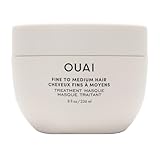
OUAI Fine to Medium Hair Treatment Masque
Best for: Fine-to-medium hair that wants moisture and shine from a mask without getting weighed down or greasy
A lightweight deep-conditioning mask with shea butter, hydrolyzed keratin, and panthenol, tuned for fine-to-medium strands
- Built for fine-to-medium hair: delivers moisture and shine without the heaviness that flattens finer strands
- Shea butter, hydrolyzed keratin, and panthenol to smooth, strengthen, and add shine
- Free of parabens, phthalates, SLS, and SLES
- OUAI is a protein-forward, keratin-containing brand, so low-porosity or protein-sensitive hair should rotate it with protein-free products
- Everything OUAI is strongly fragranced, and the signature scent is polarizing
- A premium price for a fine-hair mask, and it is the fine-to-medium formula only; a separate Thick version exists for coarser hair
(Affiliate link) · price may vary
For fine and medium hair, the problem with most masks is weight, and this one is built to avoid it. OUAI’s Fine-to-Medium masque uses shea butter, hydrolyzed keratin, and panthenol to add moisture and shine without the heaviness that flattens finer strands. A fine-haired user who reviewed it summed up the appeal as intense moisture with hair left silky, not greasy.
The honest downside is protein, and porosity. OUAI is a protein-forward, keratin-containing brand, and one low-porosity user explained that they “have to rotate with protein free products” to keep their hair balanced, which is the right move if you know your hair leans low-porosity; our porosity guide covers how to tell. Everything OUAI is also strongly fragranced, the scent is polarizing, and this is the fine-to-medium formula only, with a separate Thick version for coarser hair. It is a premium price for a fine-hair mask, so it earns its slot on fit rather than on value.
OUAI · (Affiliate link)
How often should you use a hair mask?
For most hair, once a week. Very dry, coarse, or high-porosity hair can go up to every wash; fine or easily weighed-down hair often does better every other week. The rule that matters more than frequency is not to stack repair steps, since over-loading protein and bond products is a real way to make hair worse.
Match the cadence to your hair rather than the calendar. Limp, coated, or crispy means stretch the interval or switch from a protein mask to a moisture one; rough and thirsty means shorten it. If you use a leave-in bond treatment like K18, keep it on its own schedule rather than layering it under a mask the same wash. And apply any mask to clean, squeezed-out hair, concentrating on the mid-lengths and ends, since the roots are the newest, healthiest hair and need it least. Time on the hair also matters less than the label makes it seem: follow the stated minutes rather than leaving a mask on for hours or overnight, and if your hair wants more, gentle heat under a shower cap does more than extra time.
Buying authentic: an honest note on Amazon
Buy the premium repair picks from an authorized seller. For a drugstore masque like Cantu, the risk is low. For the higher-priced bond and salon brands, K18 and Kérastase, counterfeits and grey-market stock are a known problem on third-party marketplaces, and the community regularly flags it.
This is guidance, not an accusation about any specific listing. The affiliate links on this page route to Amazon, where the listing and seller can change; the practical advice is to check that you are buying from the brand or an authorized retailer before you pay salon prices, whatever the source. A fake bond-builder is the one product where the counterfeit doesn’t just underperform, it wastes the exact repair step you were paying for.
Want to know how we choose? See about The Hair Roundup, or browse the rest of our hair-care roundups.